
Blog.
The latest digital marketing news, free guides and insights straight from Growthworx HQ.

Cost per acquisition is the one number you need before you scale your marketing
You are buying customers at a price. The only question that matters is whether that price is less than what a customer is worth to you. That price has a name. It's your cost per acquisition. Here’s how it works.
Most of the businesses I work with grew the hard way. Word of mouth, repeat custom, a good name built over years, the odd referral. It works, and it gets you to a decent size. The problem is it has a ceiling, and you usually hit it without noticing, right about the time you decide you want to grow on purpose rather than by luck.
That's the point where owners start thinking about "doing some marketing." Google ads, maybe. A push on the website. And it's also the point where it tends to go wrong, because they treat marketing as a cost to be spent and hoped over, rather than what it actually is.
Here is the shift, and it's the whole article in one line: you are not spending money on marketing. You are buying customers at a price. The only question that matters is whether that price is less than what a customer is worth to you.
That price has a name. It's your cost per acquisition.
What cost per acquisition actually is
Cost per acquisition, or CPA, is simply what it costs you to win one customer.
Take everything you spent to get customers in the door over a period, the ad budget, the tools, the time if you want to be honest about it, and divide it by the number of customers it brought you. Spend £2,000 and win 10 customers, your CPA is £200. That's it. No mystery to it.
One thing to get straight early, because it trips people up. The advertising platforms will throw the word "acquisition" around to mean a form fill, a phone call, an enquiry. That's a cost per lead (CPL), not a cost per customer. They are not the same number, and the gap between them is where a lot of marketing money quietly dies. The number you care about as an owner is the cost to win an actual paying customer, not the cost to make a phone ring.
How you work it out
The headline version is the one above: total spend divided by customers won. But the useful version is the chain underneath it, because that's where you find the levers.
It goes like this. You pay for someone to click an ad. A percentage of those clicks turn into enquiries. A percentage of those enquiries turn into customers. Stack those together and you get your real cost per customer.
A worked example, using the kind of numbers a service business or small manufacturer might actually see.
Say a click costs you £4. That's your cost per click (CPC). Your website turns 5% of visitors into enquiries. That means it takes 20 clicks to get one enquiry, so each enquiry has cost you £80. Now say you win one in every three enquiries. That's three enquiries per one new customer, so each customer has cost you £240 to acquire.
£240 is your CPA. That's the price you're paying to buy a customer.
What that number is telling you
On its own, £240 means nothing. A CPA is only good or bad next to one other figure: what a customer is worth to you.
Not what they spend, what they're worth. The profit, not the revenue. If an average customer brings in £2,000 of work at a 40% margin, that customer is worth £800 in gross profit to you. Pay £240 to win them and you've spent £240 to make £800. That's not a cost. That's the best trade in your business.
And here's the part that changes how you think about growth. Once your CPA is comfortably below what a customer is worth, scaling stops being a leap of faith. You're no longer asking "should I risk more on marketing?" You're saying "every £240 I put in comes back as £800, so how much can I afford to put in?" Marketing becomes a tap you turn up, not a gamble you take.
That's why I say everything else feeds off this number. Your click cost, your website's conversion rate, your targeting, your offer, how fast you follow up an enquiry, every one of those is just a lever that moves your CPA up or down. They only matter because of what they do to that one figure.
How you bring it down
Most owners, when they want better results, assume the answer is better ads. Sometimes it is. More often it isn't.
Go back to the example. We were winning one enquiry in three, which gave us a £240 CPA. Suppose we change nothing about the ads, but we tighten up the follow-up so enquiries actually get called back quickly and chased properly, and we start winning one in two instead. Now it's two enquiries per customer, not three, and the CPA drops to £160. We haven't spent a penny more on advertising. We've just stopped leaking customers we already paid to attract.
That's the lever owners overlook, because it isn't glamorous and it sits inside their own business rather than out on Google. A faster website, a clearer offer, a proper reason to choose you, a follow-up process that doesn't let warm enquiries go cold, all of it pushes the same number in the same direction. Lower the cost of winning a customer and every pound you spend goes further.
There's an advanced version of this too. If a customer comes back, year after year, then their real worth isn't £800, it's their lifetime value (LTV), which might be three or four times that. The business that knows its LTV can afford to pay far more to win a customer than its competitors, and still come out ahead. That's how the serious players outbid everyone and dominate a market. They're not braver. They just know their numbers.
Why this is the first thing, not the fifth
You can have the best website in your sector, the cleverest ad campaign, the slickest funnel. If you don't know what a customer costs you to acquire and what one is worth, you're flying blind, and no amount of clever fixes the fact that you can't tell whether any of it is working.
Nail this one number first and everything downstream gets easier. You know what you can afford to spend. You know which marketing to keep and which to kill. You know whether the problem is your ads, your website or your follow-up. And you can scale with confidence, because you're not hoping any more. You're buying customers at a price you've already decided is worth paying.
One honest catch to finish on: you can't manage what you don't measure. All of this depends on tracking the journey properly, from the click to the enquiry to the closed customer, so you can see your real CPA rather than guess at it. Get that measurement right and the rest is arithmetic. Get it wrong and you're back to spending and hoping, just with a nicer dashboard.
Work out what a customer costs you, and what one is worth. Until you know both, you don't have a marketing strategy. You have a hopeful direct debit.

A billion people a month are now searching Google with AI. If you're not being cited, you're not being found.
People aren't searching less because of AI. They're searching more. And the way they're searching has fundamentally changed. Just one year after launching AI Mode, Google now has over one billion monthly users running searches through its AI. Query volume has more than doubled every quarter since launch, and last quarter the total number of searches hit an all-time high.
Google held its annual I/O developer conference this week, Ive just read through their email and the announcements related to its search engine buried inside it deserve more attention from small business owners than they're getting.
Here's the headline number.
Just one year after launching AI Mode, Google now has over one billion monthly users running searches through its AI. Query volume has more than doubled every quarter since launch, and last quarter the total number of searches hit an all-time high.
Read that again.
People aren't searching less because of AI. They're searching more. And the way they're searching has fundamentally changed.
What Google actually announced
There’s three things that I can see that matter for your business:
A reimagined Search box. It's the biggest change to the Search box in over 25 years. It dynamically expands so users can describe what they actually want in full sentences, not three-word keyword stubs. They can drop in images, files, videos, or pull from Chrome tabs as part of the query. The new default model is Gemini 3.5 Flash, rolled out globally from this week.
Conversational follow-ups. Users can ask a follow-up directly from an AI Overview and slide straight into AI Mode for a back-and-forth conversation. Google's own line is the one to pay attention to: "Your context stays with you, and as you explore more deeply, the links and supporting articles get even more relevant."
Search agents. Information agents that run in the background, monitoring blogs, news sites, social posts, finance data, and shopping listings for changes related to a specific question. They synthesise updates and send them to the user. Rolling out to Pro and Ultra subscribers this summer.
The bit small business owners need to actually understand
That line about "the deeper you dig, the more relevant the links" to me is the whole game.
SEO as we know it (what I’d' call old SEO) was about simply being ranked number one for "plumber Worcester" ro whatever your key search term is.
New AI search is about being the source Google's model trusts enough to cite when someone asks, "I've got an old radiator that hisses when the heating comes on, the pressure keeps dropping, and I think the boiler might need re-pressurising. Can someone in Worcester come and look at it this week, and what should I expect to pay?"
Those two queries are not the same.
The first is a keyword match. The second is a context-rich, multi-part question that Google's AI breaks down, reasons across, and answers by pulling specific snippets from specific pages, with links sitting alongside them.
If your website is built to rank purely for keywords, it might still rank. But it won't get cited. And the citation is where the clickthrough is beginning to live. Less for locally focussed businesses right now butI would epxect this to change.
Simply look at the adoption of ChatGBT, then look at how it moved so quickly to become used for search and you’ll see the pattern of how search is changing.
Why this matters more for small businesses than for the big players
Big brands have brand search baked in. People type "Screwfix" because they already know Screwfix. The vast majority of small business search opportunity has always sat in the long tail, the specific question, the local context, the niche problem.
That long tail is exactly what AI search amplifies. The deeper and more specific the user's question, the more likely Google's AI is to pull from a long, specific page on a small website rather than from a thin, generic page on a corporate one.
But only if the page actually exists, is structured properly, and is recognisable to the model as a credible source.
What to actually do about it
A few practical points, none of them new, all of them more urgent than they were a week ago:
Write content that answers full questions, not keywords. If you sell replacement door locks in Manchester, you need a page that addresses "what's the best replacement door lock for a tradtional farm door in an old cottage", not just "door locks Manchester".
Get your schema markup sorted. Structured data is how you tell Google's AI what your page actually is, who you are, what you charge, what other people have said about you. Without it, you're invisible to the model in any structured sense. Service schema, FAQ schema, review schema, organisation schema, product schema. All of it.
Build trust signals the model can actually read. Real reviews with structured data. Real author bios. Real business information that matches across your site, Google Business Profile, and the rest of the web. Inconsistency makes you look like a low-trust source.
Stop thinking in pages, start thinking in answers. Every page on your site should be the best possible answer to a specific question a customer might ask. If a page doesn't answer a question, it's not earning its keep.
Get your Google Business Profile fully populated. Hours, services, products, photos, posts, the lot. It's the foundation of local AI citation.
It all comes back to one thing, it’s called Topical Authority which I’ve been writing about in The Digital Debrief for years ( and banging the drum loudly about it with my clients - sorry clients!) and it’s actually a really really simple thing to understand:
If Google sees your business website as the authority on its topic then it will refer to it when someone wants to find out something. That meant previouslly it would refer to it in its search results. Today that means it will refer to it in it’s AI search results.
Trust me on this, if you’re not on the case you will get left behind.
The bottom line
A billion people a month are now interrogating Google through AI rather than typing keywords. They're asking longer, more specific questions, and they're getting more specific answers with more specific links.
The businesses being cited in those answers are winning the clicks. The ones who haven't structured their site for that shift are quietly losing visibility without ever seeing a ranking drop, because the ranking system itself is no longer the only game.
If you've been putting off the SEO conversation because the old model felt like a lottery, the new model is more deterministic than people realise. It rewards depth, specificity, structure, and trust. All of which are within reach of any small business willing to take it seriously.
The window to get ahead of competitors who are still treating this as next year's problem is open right now. It won't be open for long.
Here to help if you’re business needs it.
Thanks for reading,
Ollie
(Source: Google's I/O 2026 announcement, "A new era for AI Search", Elizabeth Reid, VP Search, 19 May 2026)

What is Growth Marketing and how it can help your business.
If traditional marketing is about getting attention, growth marketing is about turning attention into revenue and revenue into more revenue. Here’s a deep-dive into how it works.
Growth marketing is a commercial approach to marketing that uses data and experimentation to grow a business across the whole customer journey, not just the top of the funnel. Instead of chasing more traffic or bigger ad budgets, growth marketing looks at every stage from first click to repeat purchase, works out what's leaking, and fixes it.
If traditional marketing is about getting attention, growth marketing is about turning attention into revenue and revenue into more revenue.

Growth marketing in plain English.
Most marketing focuses on the start of the customer journey. Build awareness, drive traffic, generate leads, hand it over to sales. Job done.
Growth marketing pushes past that. It treats the whole funnel as the marketer's responsibility, from the moment a prospect hears your name through to them becoming a repeat customer who tells their friends. Every stage gets measured, every stage gets tested, and the effort goes into the parts that move the commercial needle most.
The easiest way to spot the difference is to look at what's being measured. A traditional marketer might celebrate a campaign that doubled website traffic. A growth marketer would ask what that traffic converted into, how much it cost per enquiry, how many of those enquiries turned into paying clients, and what those clients were worth over twelve months. The traffic number doesn't matter on its own.
Where the term came from.
Growth marketing grew out of the tech startup scene in the early 2010s, where founders needed to acquire users fast on small budgets and couldn't afford traditional marketing. The approach became known as "growth hacking" and leaned heavily on testing, data, and clever channel work.
Over the last decade it's matured into something far broader. Growth marketing is now used by companies of every size, including owner-managed SMEs, because the core principles are useful everywhere: focus on commercial outcomes, test before you commit, measure what matters, and keep the funnel moving.
Growth marketing vs traditional marketing.
Traditional marketing is usually measured by activity. Ads running, campaigns launched, impressions generated, content published. It tends to operate in a line: build awareness at the top, hope some of it converts at the bottom.
Growth marketing is measured by outcome. Revenue, customer acquisition cost, lifetime value, retention, referral. It operates as a loop: every customer becomes data, every campaign becomes an experiment, every result feeds the next decision.
Here's the difference in practice.
A traditional campaign might run a month of social ads, produce a report showing reach and engagement, and move on to the next idea. A growth marketing campaign would split that same budget across three or four different angles, measure which one generated the most enquiries at the lowest cost, cut the losers, double down on the winner, and feed what was learned into the next test.
One assumes marketing is finished when the campaign ends. The other treats every campaign as raw material for the one after it.
Growth marketing vs digital marketing.
Digital marketing is the set of channels, SEO, paid ads, social, email, content, and so on. Growth marketing is an approach to using them. You can do digital marketing without doing growth marketing, and in fact most SMEs do. They run ads, post on social, send the odd email, and hope.
Growth marketing takes those same channels and points them at commercial outcomes, tests relentlessly, and joins them together so each one strengthens the others. Digital marketing is the tools. Growth marketing is how you use them to make money.
The marketing funnel, and why most businesses only market to the top of it.
The marketing funnel is just the journey a stranger takes to becoming a paying customer, and then a repeat one. It's called a funnel because a lot of people go in at the top and only a few come out as paying clients at the bottom.
There are usually four or five stages, depending on who's drawing the picture, but in plain English they come down to this:
Top of the funnel: People who don't know you exist yet. The job here is to get noticed.
Middle of the funnel: People who've heard of you and are weighing you up against the alternatives. The job here is to build trust and stay front of mind.
Bottom of the funnel: People who are ready to buy. The job here is to make it easy and not lose them in the follow-up.
After the sale: Customers who've bought once. The job here is to keep them coming back and get them recommending you.
Most small businesses only market to the top of the funnel. They spend on ads, SEO, and social to drive traffic, and then leave the rest to chance. The website does what it can, the sales process does what it can, and what happens after the first purchase usually isn't marketing's problem.
The numbers don't support that approach. The top of the funnel is the most expensive stage to play in, because everyone else is there too. Ads are pricey, SEO is competitive, and attention is fought over. The middle and bottom of the funnel are cheaper, warmer, and far more profitable, because the people there already know you.
Growth marketing looks at the whole funnel and puts the money where it earns its keep. That usually means:
Better conversion on the website, so more of the traffic you've already paid for turns into enquiries
A proper follow-up sequence, so leads don't go cold between the first enquiry and the first sale
An onboarding experience that gets customers to their first win quickly, so they stick around
Retention and upsell campaigns, so existing customers spend more over time
A referral programme, so happy customers become a source of new ones
Fix the bottom of the funnel first and the top gets cheaper. The same ad budget generates more revenue because less of it leaks out along the way. The same SEO traffic produces more enquiries because the site does a better job with the visitors it already has. Every pound spent at the top works harder.
It's the single biggest shift in thinking that separates growth marketing from traditional marketing. Traditional marketing tries to pour more in at the top. Growth marketing patches the holes in the rest of the funnel first.
The principles that make growth marketing work.
Every business does growth marketing slightly differently, but the principles are the same.
It's commercial first, marketing second.
The job isn't to produce marketing, the job is to grow the business. If a slick campaign doesn't move revenue, it's not working, no matter how well it performs on vanity metrics.
It covers the whole funnel.
Growth marketing is as interested in retention as it is in acquisition, and often more. Keeping a customer costs a fraction of winning a new one, and the easiest revenue is the revenue you're already leaving on the table.
It runs on data, not opinion.
Decisions get made on what the numbers say, not what the founder or the agency thinks looks good. That means tracking needs to work before anything else does.
It's built on experiments.
Every meaningful change gets tested before it gets rolled out. Two versions of an email, two landing pages, two offers, run them both, see which one wins, use that one, test the winner against something new. Progress compounds.
It's multi-channel and joined up.
One channel in isolation is fragile. Google Ads that lead to a weak landing page waste money. SEO without follow-up nurtures wastes leads. The channels need to hand off to each other cleanly.
It responds quickly.
Growth marketers don't wait six months to see if something's working. The feedback loops are short, the pivots are fast, and the direction is set by what the data says this month, not what the plan said last quarter.
The five stages of the growth marketing funnel.
Growth marketers usually think about the customer journey in five stages. Different frameworks give them different names (acquisition, activation, retention, revenue, referral is the common one) but in plain English they come down to this:
Getting noticed
How do prospects find out you exist? SEO, ads, referrals, content, PR, word of mouth. This is the top of the funnel.
Getting them interested
What turns a stranger into someone who's actually considering spending with you? Usually the website, the language and messaging, the first email, the first conversation.
Getting them to buy
What closes the deal? Landing pages, sales follow-up, proposals, the checkout.
Getting them to stay
Once they've bought, what keeps them coming back, upgrading, or sticking with a retainer? Onboarding, service quality, email, account management.
Getting them to refer
What turns happy customers into unpaid salespeople? Reviews, referral programmes, case studies.
Most SMEs pour nearly all their budget into the first stage. Growth marketing looks at which stage is actually leaking the most revenue and fixes that one first. More often than not, it's not the top.
What growth marketing actually looks like in an SME.
Frameworks are fine but the proof is in the practice. Here's what growth marketing looks like in the kinds of businesses I work with.
A local tradesman getting 40 visits a month to his website and two enquiries. A traditional fix is to spend more on Google Ads to double the traffic. A growth marketing fix is to rebuild the site so it converts at 8% instead of 5%, add a Google Business Profile that generates its own enquiries, get 20 fresh reviews, and set up an email that goes to every past customer asking if they've got work coming up. The traffic stays the same. The enquiries triple.
A B2B consultancy generating leads from LinkedIn but struggling to close them. A traditional fix is to run more LinkedIn ads. A growth marketing fix is to build a nurture sequence that emails leads weekly with useful content, adds a case study to every proposal, and rewrites the website to lead with outcomes rather than services. Close rate doubles on the same lead volume.
An e-commerce brand with a cost per acquisition that's eating the margin. A traditional fix is to cut ad spend. A growth marketing fix is to build an abandoned basket sequence, add a post-purchase email series that asks for a review and cross-sells a complementary product, and set up a loyalty offer for repeat buyers. CPA stays the same. Lifetime value doubles. The ads that were unprofitable yesterday are profitable today.
In every case, the lift comes from looking at the whole funnel, not just the top.
Channels and tactics used in growth marketing.
Growth marketing doesn't have its own channels. It uses the same ones every other marketer does. What makes it growth marketing is how they're chosen and how they work together.
SEO and content build authority and pull in free traffic over time. Growth marketers prioritise search terms with commercial intent, not vanity keywords.
Google Ads and paid social generate traffic on demand. Growth marketers test ad copy, audience, and landing page in combination, not in isolation.
Email marketing and automation do the work of turning leads into customers and customers into repeat buyers. Growth marketers treat email as a long-term asset, not a monthly broadcast.
Referral and partnership channels compound faster than almost anything else but are usually ignored. Growth marketers design them in.
Sales process and CRM are marketing channels too, because most leads are lost in the follow-up, not in the acquisition. Growth marketers measure conversion at every stage.
Website and landing pages are where every channel eventually lands. A small lift in conversion rate has a bigger effect than almost any other change.
The specific mix depends on the business, the audience, and the stage. There's no single playbook.
Why we feel growth marketing needs both sides of the brain.
Most growth marketing content online leans heavily on the data side. Dashboards, A/B tests, conversion rates, cost per acquisition. It's all important and none of it matters on its own.
The other half of the job is creative. The ad that actually gets clicked. The email subject line that gets opened. The landing page headline that makes someone stay rather than bounce. The offer that's compelling enough to act on. You can run all the tests you like, but if the creative is weak, you're just measuring which version of mediocre performs marginally better.
The best growth marketing sits on both sides. Creative enough to produce work that earns attention, data-led enough to know which version of it actually pays its way.
I've spent 20+ years working across both. Sales and management gave me the commercial head. Years of running campaigns, writing copy, and shaping brands gave me the creative one. When I take on a growth consultancy engagement, you get both in the same person. No handoffs, no waiting for the creative team to get back to you, no analyst who can't write an ad.
That matters more than it sounds. A lot of the problems SMEs hire growth marketers to fix aren't data problems at all. They're clarity problems. The positioning is fuzzy, the copy doesn't land, the offer isn't sharp. The data tells you something's wrong. It takes a different skill to work out what to do about it.
Common growth marketing mistakes.
Treating it as a single tactic rather than an approach.
Growth marketing isn't SEO. It isn't email. It isn't A/B testing. It's the discipline of tying all of them to commercial outcomes. Businesses that hire a "growth marketer" to run paid ads in isolation haven't done growth marketing, they've just done paid ads.
Measuring the wrong things.
Traffic, followers, engagement, email opens. None of them matter on their own. The only metrics that count are the ones that tie to revenue and margin.
Testing too small.
Changing the colour of a button rarely moves anything. Testing a whole new offer, a new audience, or a new channel moves the needle. Focus the experiments on decisions that matter commercially.
Skipping the plumbing.
If Google Analytics isn't tracking conversions properly, every decision downstream is guesswork. The tracking has to work before anything else does.
Giving up too early.
SEO, email nurture, and referral channels compound. They're slow for six months and then accelerate. Most SMEs cut them just before they start working.
When growth marketing isn't right for your business.
Growth marketing isn't a fit for every business. There are three situations where it's usually the wrong call.
You don't have a product or service that's working.
Growth marketing amplifies what's already there. If the thing you're selling isn't landing with customers, marketing won't fix it so fix the offer first.
You can't track results.
If your sales are offline, your CRM is a spreadsheet, and you can't attribute enquiries to channels, the feedback loop that growth marketing depends on isn't there. Building the tracking is the first job.
You need short-term leads and can't wait.
Some parts of growth marketing, particularly SEO, content, and retention, pay off over months and years, not weeks. If you need enquiries next week, you need paid ads, not a growth strategy. Growth marketing includes paid ads, but it's not a quick fix on its own.
How to know if growth marketing is working.
The honest answer is that most of it compounds, which means the early signs are quieter than you'd like.
In the first three months, expect to see the foundations right. Tracking working, website converting better, positioning sharper, early channel tests producing cleaner data. Revenue may not have shifted yet.
In months three to six, expect paid channels to be profitable, retention and email to start contributing, and SEO to show early movement.
In months six to twelve, expect compounding. SEO traffic climbing, referral kicking in, lifetime value going up, cost per acquisition going down. The businesses that win at growth marketing are the ones that stay the course through the slow bit.
The metric that matters most is the one that ties activity to revenue: cost per acquisition compared to average customer value. Get that ratio right and everything else follows.
How to implement growth marketing in a small business.
You don't need a full team or an agency to do growth marketing. You need the right foundations and the right focus.
Start with the numbers. Set up Google Analytics 4, Search Console, and basic conversion tracking. Know where your enquiries come from before you spend a penny more on marketing.
Audit the funnel. Where are you losing people? Traffic to enquiry, enquiry to quote, quote to booking, first purchase to repeat. Whichever stage is leaking worst is the first one to fix.
Pick two or three channels. Not all of them. Two or three, the ones most likely to work for your business and stage, and go deep on those. Master them before adding more.
Build one thing that compounds. SEO, email nurture, or referral. Something that gets stronger every month rather than starting from zero each time.
Measure, adjust, repeat. Every month, look at what worked, what didn't, what to test next. Keep the review tight, the cycles short, and the decisions based on data.
That's it. The principles aren't complicated. The discipline of sticking to them is the hard bit.
How we help SMEs with growth marketing.
At Midlands Digital we work with owner-managed SMEs across the UK as their outsourced growth lead. That means one person running strategy and execution across website, SEO, ads, content, and sales process, joined up and pointed at commercial outcomes.
Most of my clients have tried the fragmented version, a web agency, a social agency, a freelance SEO, maybe a VA doing content. The pieces never add up because nobody owns the whole thing. Growth marketing under one roof, with a commercial head on it, tends to outperform the agency-juggling approach by a distance.
If you want to talk about what that might look like for your business, the first step is a Growth Chat. No proposal, no pressure, just a useful conversation about where you are and where you want to go.
Frequently asked questions.
Is growth marketing just another name for digital marketing?
No. Digital marketing is the set of channels. Growth marketing is an approach to using them that focuses on commercial outcomes and covers the whole customer journey rather than just the top of the funnel.
Is growth marketing only for startups?
No. The approach came from the startup world but it works for any business that wants marketing tied to revenue. Owner-managed SMEs often benefit more than startups because the commercial outcomes are clearer and the feedback loops are shorter.
How long does growth marketing take to work?
Paid channels can produce results within weeks. SEO, content, email nurture, and referral usually take three to six months to build and six to twelve to hit full stride. Most meaningful results compound, so the businesses that win are the ones that stay the course.
Do I need a growth marketer or an agency?
It depends on size. Businesses turning over under £500k usually do better with a single outsourced growth lead who can cover strategy and delivery. Businesses above that might bring someone in-house or run a hybrid model.
Is growth marketing expensive?
The core approach is about getting more out of what you're already spending, so it often saves money rather than adding to the budget. A proper growth marketing retainer for an SME typically starts around £1,500 to £3,000 a month depending on scope.
How is growth marketing different from growth hacking?
Growth hacking is a subset, focused on short, creative experiments to drive acquisition, usually in early-stage tech. Growth marketing is broader, slower, and more sustainable. It covers the whole funnel and builds assets that compound over time.
What's the first thing to do if I want to try growth marketing?
Get the tracking right. Until you can see where your enquiries come from and what they're worth, every decision downstream is guesswork. Set up Google Analytics 4, Search Console, and conversion tracking, then start from there.

The Google March 2026 Core Update: What happened and what It means for your website
One of the most disruptive Google updates in recent memory has finished rolling out. Here is what changed, who was affected, and what owner-managed businesses should do about it.
If your website traffic has moved noticeably over the last three weeks, you are not imagining it. Google began rolling out its March 2026 Core Update on 27 March and officially completed it on 8 April. It was the first broad core update of the year, and by almost every measure it was more disruptive than the December 2025 update that preceded it.
This article breaks down what actually happened, what it means for small and owner-managed businesses, and the practical steps to take next.
What the March 2026 core update actually was
A core update is simply a broad recalibration of how Google ranks pages. To be clear it is not a penalty, Google is not flagging individual sites for wrongdoing. It is re-weighing how its ranking systems judge quality, relevance and trust across the entire web, and then letting the results settle.
What made this one different was the scale, the timing, and the context around it.
The headline numbers
Volatility peaked at 9.5 out of 10on the SEMrush Sensor, higher than the December 2025 core update.
More than 55% of monitored websites experienced measurable ranking shifts in the first two weeks.
79.5% of top-three results changed position during the rollout, up from 66.8% in December.
About 24% of pages that had been ranking in the top 10 dropped out of the top 100 altogether, according to SE Ranking data.
Some sites reported organic traffic drops of 20 to 35% in the first week. Others saw meaningful gains. That split, winners and losers in roughly equal measure, is the defining feature of a broad core update.
The context nobody is talking about
The core update did not arrive in isolation. It was the third algorithm change in five weeks, following a February Discover-only update and a March 24 to 25 spam update. Reports show that spam update completed in under 20 hours, the shortest confirmed spam update in dashboard history.
The sequence was not coincidence. Clearing spam signals first and then recalibrating quality rankings is a logical order. Websites propped up by manipulative link-building had their supports kicked away before the core update arrived to judge content quality in a cleaner environment. Some sites were caught by both. Untangling which update caused which traffic change now requires careful date-by-date analysis in Search Console.
And just to be clear manipulative link-building isn’t great so if you’re on the wrong side of that I’m probably not going be losing much sleep for you.
Who lost and why
The pattern in the data is clear. The sites hit hardest share a small number of characteristics.
1. Mass-produced poor AI content
This is important to get right. Google did not ban AI content. Let me just reiterate this: Google did not ban AI content.
AI-assisted content that has been edited by a human with real expertise, with original examples and data added, is seemingly performing fine. What dropped was content where AI was used as a replacement for expertise. Pages that read fluently but add nothing original, nothing first-hand, and nothing the reader could not already find elsewhere.
The threshold Google appears to be applying is whether the page offers value that an AI summary of existing search results could not already provide. If it does not, it is likely to be vulnerable.
2. Programmatic SEO and thin templates
Sites that generate hundreds or thousands of near-identical pages by swapping out location names, product specifications or keyword variations have taken a heavy hit. City-by-city service pages that change only the town name. Product comparison pages that list specs without any analysis. Best-of pages built from the same template across thousands of variations. The quality bar on this kind of content has risen sharply.
3. Thin affiliate and aggregation content
Pages that simply rephrase what already ranks in the top ten for a given query, without adding proprietary data, first-hand experience or a unique perspective, are losing ground fast. Google is now explicitly rewarding originality over aggregation.
Now let’s look at who won and why…
Who won and why
The winners had the opposite profile. Clear expertise. Original content that could not easily be found elsewhere. Niche depth rather than generalist breadth. Strong trust signals on the page and at the domain level.
From what I’v read two findings stand out.
73% of top-ranking YMYL pages (Your Money or Your Life, meaning finance, health, legal and anything that affects someone's wellbeing or livelihood) now display clear author credentials. It’s a solid trust signals that’s now doing real work.
Sites publishing original data saw average visibility increases of around 22%, according to analysis of more than 600,000 pages. Adding something that did not previously exist on the web is now one of the clearest routes to ranking.
In plain terms, and something I’ve been banging on about for years now is that Google is tightening the screws on E-E-A-T which stands for Experience, Expertise, Authoritativeness and Trustworthiness.
The sites that can prove all four are pulling away from those that cannot. Those that don’t are now falling behind and the impact is compounding but not in a good way.
Client note 1 - If we’ve been working on content strategy and development together, this is why. Although it doesn’t necessarily give you instant wins ‘today’ it stands you in good stead with Google and that will only become more important going forward.
What this means for owner-managed businesses
To be frank (not literally of course!) most of what has been written about this update is aimed at large publishers and affiliate operators. The implications for small businesses, tradespeople and local service providers actually look a little different.
The good news is that many owner-managed businesses are naturally well-positioned for what Google now rewards. Real expertise from years in the trade. Genuine first-hand experience with real clients. Local knowledge that cannot be scraped from a competitor's site. Authentic photographs of real work. All of these translate directly into the signals Google is now paying more attention to.
The less good news is that any shortcuts still lurking on a website are now more exposed. Stock photography on a tradesperson's site. Crappy poor quality content. Thin location pages for towns the business does not really serve, etc, etc… All of that looks worse in the post-update environment than it did a month ago.
Client note 2 - If I have been asking in the last 12 months for real portfolio images, case studies and your own ‘behind the scenes at ABC Corp’ blog content, again this is why. As much as I can do to boost and maintain your websites search engine result positions it’s now more critical than ever to get these things in place. If you’ve got something sat gathering dust on your todo list from me please get it actioned.
What to do now
I know the the temptation after a volatile update is to panic edit. Rewrite everything. Delete pages. Change titles. But please don’t. From what I’ve seen over the years that almost always makes things worse. Google is way smarter than you quickly flipping your website and as always the right approach needs to be data driven, disciplined and evidence-led.
1. Diagnose before deciding
Open Google Search Console and look at the Performance report. Compare the two weeks before 24 March against the two weeks after 8 April. Filter by date, by page and by query. Look for sharp breaks rather than general drift. If your traffic dropped on 24 or 25 March, the spam update is the likely cause. If it began on 27 March, it was the core update. If it began earlier and relates to Google Discover, that is the February update still working through.
Also a heads up - be aware that Google confirmed a Search Console data bug that inflated impression counts from 13 May 2025 to early April 2026. Some of the apparent drop in impressions is a correction rather than a ranking change. Clicks and conversions are the more reliable numbers right now.
2. Audit content for genuine value
Go through your pages and ask an honest question of each one’s true value and topical authority, then either add what is missing, first-hand experience, proprietary data, expert opinion, original photography, or accept that the page is not pulling its weight.
Thin pages that exist only to target a keyword are now actively dragging on the authority of the rest of the site. We all have to evolve our approach and accept that what worked 2 years ago doesn’t be default work today. In fact when Google flips up its algoryt sometimes what worked 6 months ago wont work today.
My view (and it is just a view right now as opposed to hard fact) is that for this type of content removing them would help the pages that remain.
3. Make expertise visible
If the person behind your business has real experience, say so, and show it. Author bios with credentials. Photographs of real work and real team members. Case studies with named clients where possible. Dates, locations and specifics rather than vague claims. Every concrete detail is a trust signal.
This matters particularly for anything touching finance, health, legal or safety. The trust bar in those categories is now measurably higher than it was just a few weeks ago in February.
4. Replace stock with real
For trades and local service businesses, this is often the quickest win. Replace generic stock photography with photographs of actual jobs, actual vans, actual team members, actual premises. It takes an afternoon and it shifts the whole character of a site in Google's eyes and in a prospect's.
If you’re DIY’ing this then set the stage to get the best outcome possible from your phone camera, I wrote about how to take great photos of your work using just your phone back on the 5th March with some quick-win tips.
But if you can stretch to it I would always recommended getting the services of professional photographer. For a few hunded quid/dollars you would be amazed in the difference in quality. Consider it an investment in both your website and any printed materials you may use.
5. Be patient
Recovery from a core update rarely happens quickly. Google itself says improvements often do not show up until the next core update runs. That could be several months away. Changes made now are planting for a future harvest. Expecting a rebound in two weeks is setting up for disappointment.
The bigger picture
The March 2026 update is not an aberration. It is the next step in a direction Google has been moving for several years. Original over aggregated. Expert over generic. First-hand over second-hand. The era of winning at search through sheer volume of content is closing.
For owner-managed businesses, that is actually good news. The things that separate a real business from a content farm, genuine experience, actual clients, real photographs, a named expert behind the work, are exactly what Google is now rewarding more heavily. The update widens the gap between businesses doing real work and websites that are simply manufactured to rank.
The businesses that come out of this update strongest will be the ones that treat it not as a problem to be fixed, but as a recalibration worth aligning to.
Thank for reading,
Ollie
Sources
1. Search Engine Land, Google March 2026 core update rollout is now complete
2. Search Engine Land, March 2026 Google core update more volatile than December: SE Ranking data
3. ClickRank, Google March 2026 Core Update: What Changed and What To Do
4. Digital Applied, Google March 2026 Core Update: Impact and Recovery Guide
5. Medium, What Has Changed After Google's Core Update in March 2026?
6. Google, Search Status Dashboard
If you are unsure whether your site has been affected, or you want a second opinion on what you are seeing, get in touch for a no-obligation review.
Sign up to my free newsletter here for more news, useful tips, insights and guidance.
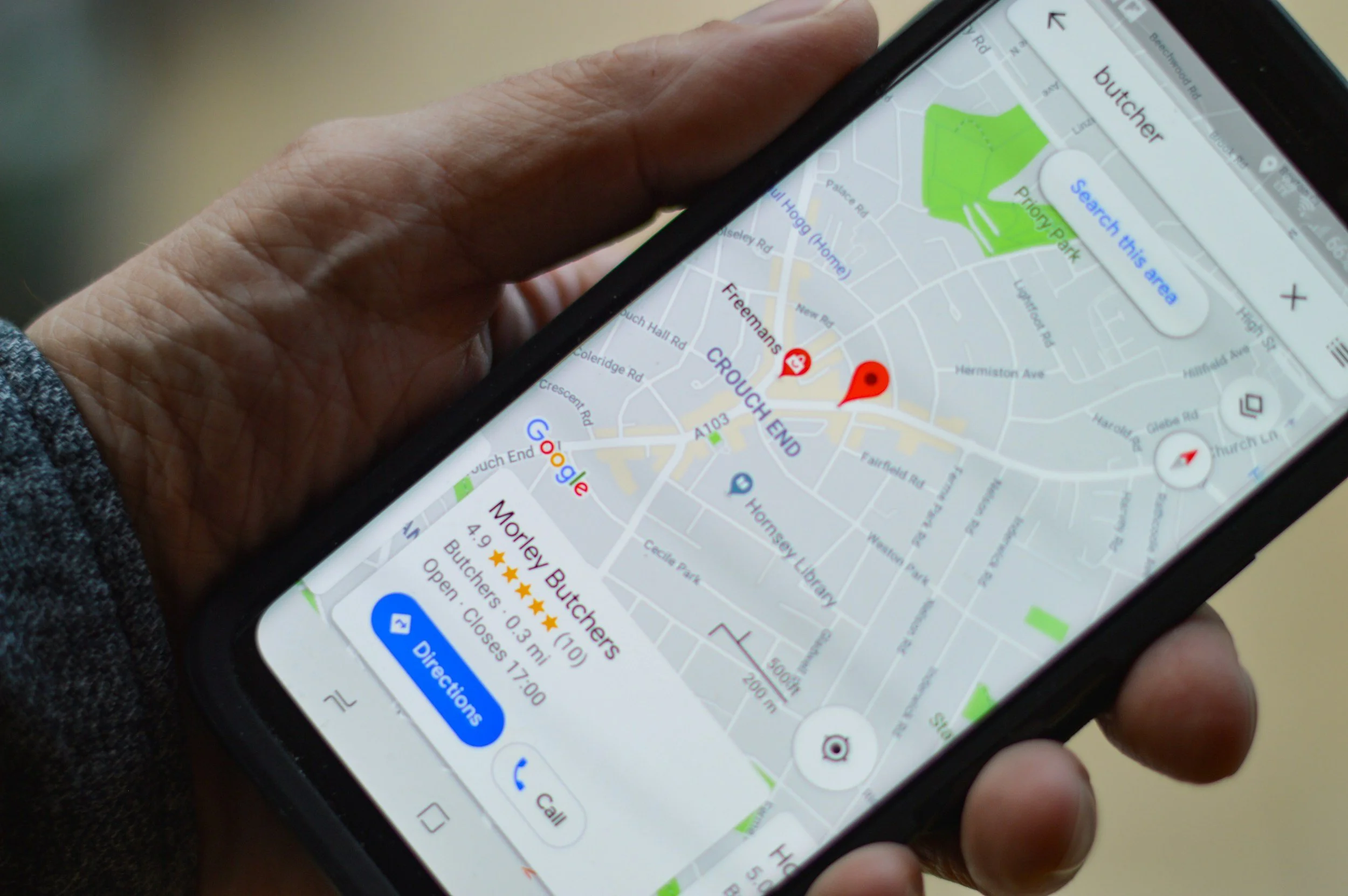
How to set up your Google business profile to do better in 7 easy steps.
Your Google Business Profile is free and powerful. Here is how to set it up from scratch in under 20 minutes.
If someone searches for your business on Google and nothing comes up, that is a problem. A Google Business Profile is the listing that appears on the right-hand side of search results, or at the top of the map when someone searches for a business like yours nearby. It shows your address, phone number, opening hours, photos, and reviews. It is free, and it is one of the most effective things a small business can do to get found online.
This guide walks you through setting one up from scratch. It takes around 20 minutes, and the only thing you will need is a Google account.
First, a quick check…
Before you set anything up, it is worth checking whether a profile for your business already exists. Google sometimes creates listings automatically using information it finds online or you may have made one years ago and forgotten about it.
If your business has been trading for a while, there is a good chance something is already out there. To check, open Google and search for your business name along with your town or location. For example: Riverside Plumbing Malvern or The Coffee Bean Shed Chelsea.
On googles search results look at the map and the panel that appears adjacent to it. You may need to scroll down past the first few results to find it and it will likely show the local map and 3 recommended business listings.
If you don’t see your business click the button thst says ‘More businesses’ to expand the box so that you see all the businesses it is listing.
If a listing appears with your business name, you will need to claim it rather than create a new one. There is usually a link that says "Own this business?" or "Claim this business" which will take you through a short verification process.
If nothing comes up, you are starting from scratch. Follow the steps below.
Step 1: Go to Google Business Profile
Open your browser and go to business.google.com. Click "Manage now" and sign in with your Google account. If you do not have one, you can create one for free at google.com/accounts.
Step 2: Search for Your Business
Google will ask you to type in your business name. Do this before assuming you need to create a new listing. Sometimes a profile already exists, perhaps created automatically by Google or by a previous owner of the premises. If you find your business, you can claim it rather than starting from scratch.
If nothing comes up, select "Add your business to Google" and continue.
Step 3: Choose Your Business Category
You will be asked to pick a category that describes what your business does. This matters more than it might seem. Google uses it to decide when to show your listing in search results. Choose the category that most closely matches your main service, and do not overthink it. You can change it later.
Step 4: Add Your Location
If customers can visit you in person, such as a shop, clinic, or studio, enter your address. Google will ask you to confirm the location on a map.
If you work from home or travel to clients, you can choose not to display an address. Instead, you can set a service area to show which towns or regions you cover. Many sole traders and small businesses operate this way, and it is a perfectly valid option.
Step 5: Add Your Contact Details
Enter your phone number and website address. If your website is brand new, use the URL you have been given. This is the link between your Google listing and your site, so it is worth double-checking it is correct.
Note - Your URL is your websites domain name address and will look something like www.mybusinessname.co.uk or www.mybrandname.com
Step 6: Verify Your Business
Google needs to confirm that you are the actual owner of the business before your profile goes live. The most common method is a postcard sent to your business address. It arrives within five days and contains a code you enter online to complete verification.
Depending on your business, you may also be offered verification by phone, email, or video call. If you are given a choice, phone or email is quicker.
Until verification is complete, your profile will not appear publicly on Google. Do not skip this step.
Step 7: Complete Your Profile
Once verified, log back in and fill out as much detail as you can. The more complete your profile, the better it performs. At a minimum, make sure you have added:
Your opening hours, including any days you are closed
A short description of what your business does (keep it factual and clear)
At least three or four photos, including your premises or team if relevant, and any work you are proud of
Your service areas or the products you offer, depending on your business type
A Few Things Worth Knowing
Reviews matter. Once your profile is live, start asking satisfied customers to leave a Google review. A short, polite request by email or in person works well. Aim to respond to every review you receive, positive or negative. It shows you are engaged, and Google notices.
Keep it up to date. If your hours change, you move premises, or you add a new service, update your profile. Outdated information frustrates potential customers and damages trust.
Post occasionally. Google Business Profile lets you publish short posts, similar to social media updates. A monthly post about a recent project, a promotion, or a piece of news helps keep your listing active and relevant.
What Comes Next
Getting your profile live is the starting point. The businesses that get the most from Google are the ones that treat their listing as an active part of their marketing rather than a one-time task. If you would like help optimising your profile to improve your local search rankings and generate more enquiries, that is something I work on with clients as part of an ongoing growth marketing programme and you can contact me here for more information.
How to Get More Google Reviews: A simple guide for small business owners.
Let's be honest Google reviews are kind of a big deal. 🌟
Think about the last time you tried a new restaurant, booked a tradesperson, or picked a local service. Did you check the reviews first? Of course you did. Everyone does.
Here's the good news: getting more Google reviews isn't complicated, it doesn't cost a penny, and it can make a massive difference to your business. More reviews = more trust = more customers. Simple as that.
In this guide I'm going to show you exactly how to find your Google review link, give you a copy-and-paste message template you can send to customers right now, and share my top 10 tips for making reviews roll in on autopilot. Let's crack on.
Step 1: Find Your Google Review Link
Before you can ask anyone for a review, you need your unique Google review link. Here's how to grab it in under two minutes:
Search for your business on Google (just type your business name into the search bar)
In your Google Business Profile panel on the right, scroll down and click "Ask for reviews"
Google will show you a short link — something like g.page/r/[yourcode]/review
Copy that link and save it somewhere handy — your phone's notes, a pinned message to yourself on WhatsApp, wherever works for you
💡 Can't find the 'Ask for reviews' button? You can also get to it via your Google Business Profile dashboard at business.google.com. Log in, select your business, and look for 'Get more reviews' in the Home tab.
Step 2: Your Copy-and-Paste Review Request Template
Now you've got your link, you need a message to go with it. Here are two versions, one for WhatsApp and one for email. Swap in your own details where you see the brackets.
📱 WhatsApp Version
Hey [Customer Name]! 👋
Really hope you're happy with everything, it was great working with you!
If you've got 60 seconds, it would mean the world to us if you could leave a quick Google review. It really helps other people find us! ⭐⭐⭐⭐⭐
[PASTE YOUR GOOGLE REVIEW LINK HERE]
Thanks so much — really appreciate it! 🙏
📧 Email Version
Subject: A quick favour, [Customer Name]?
Hi [Customer Name],
Thank you so much for choosing us, it was a real pleasure working with you on [job description]. I really hope you're pleased with the result!
I have a small favour to ask. Would you be willing to leave us a quick Google review? It only takes about 60 seconds but makes a huge difference in helping other local customers find us.
Just click the link below and it'll take you straight there:
👉 [PASTE YOUR GOOGLE REVIEW LINK HERE]
Thank you so much, I really appreciate your time and your support.
Warm regards, [Your Name] | [Your Business Name] | [Your Phone Number]
Here’s My Top 10 Tips for Getting More Google Reviews.
Right, you've got your link and your template, now let's make sure you're actually using them. These are the tips I give every single one of my clients, and they work.
1. Always ask. Every time. No exceptions.
This sounds obvious but most small business owners simply don't do it. Make asking for a review a non-negotiable part of every job completion. Your customers like you they just need a nudge. The worst they can say is nothing.
2. Ask at the right moment.
The golden moment is right after the job is done and the customer is buzzing. When they've just seen the finished result, when you've handed over the keys, when they've just said "it looks amazing" that's your cue. Ask right then, or send your message that same evening while the feel-good is still fresh.
3. Make it stupid easy with a direct link.
Never just say "leave us a Google review" and leave them to figure it out. Send them your link directly, it takes them straight to the review box with zero faff. The easier you make it, the more reviews you'll get.
4. Ask in person and follow up in writing.
Mention it face-to-face when you're wrapping up, then send a WhatsApp or email that same day with the link. The in-person ask builds commitment, the follow-up message makes it easy to actually do it. One without the other is only half as effective.
5. Be specific — ask for a 5-star review.
Don't be shy about this. If you've done a great job, it's absolutely fine to say "I'd love a 5-star review if you feel we've earned it." You're not being pushy, you're being clear. Customers who are happy are often relieved you've given them a steer on what to do.
6. Save your link in your phone right now.
Go and do it now. Save your Google review link in your notes app, create a shortcut on your home screen, or stick it in a saved WhatsApp message to yourself. When the moment arrives, you want to share it in seconds, not be hunting around trying to find it.
7. Add your review link everywhere.
Put it in your email signature. Add it to your invoices. Print it on your business cards. Stick a QR code on your van or in your reception. Add a call-to-action on your website. The more places it lives, the more reviews you'll pick up passively without even having to ask.
8. Respond to every single review, even the bad ones.
When you reply to reviews, it shows potential customers that you're a real, engaged business owner who cares. Respond to 5-star reviews with warmth and gratitude. Respond to critical reviews calmly and professionally, future customers are watching how you handle it. A well-handled negative review can actually build more trust than another glowing one.
9. Don't wait for a big project, reviews work for small jobs too.
A lot of business owners save the review ask for a big contract or an impressive job. Don't! Ask after every positive interaction. A quick call-out, a small design job, a half-day consult, these are all fair game. Volume of reviews matters just as much as the content of them.
10. Set yourself a weekly reminder.
At the end of every week, take 10 minutes to go back through that week's completed jobs and send review requests to anyone you haven't already asked. Consistency beats perfection, even one extra review a week adds up to 50 new reviews a year.
Sign up to my free newsletter here for more news, useful tips, insights and guidance.
Why Your Business Needs a Growth Marketing Partner Not Five Different Agencies
There's a version of marketing that looks busy but goes nowhere.
You've got an SEO agency working on your rankings. A web designer who built your site eighteen months ago and you haven't heard from since. A freelancer posting on Instagram three times a week. Someone who did your logo. Maybe a consultant who wrote a brand strategy document that's sitting in a folder nobody opens.
Each of them is doing their thing. None of them are talking to each other. And you — the business owner — are somehow expected to hold it all together, brief everyone separately, and figure out why none of it seems to be actually growing your business.
This is the multi-agency trap. And it's more common than you think.
What Is a Growth Marketing Partner.
Let's start with what it isn't.
It isn't an agency that does one thing well and invoices you every month regardless of results. It isn't a supplier you brief and forget. It isn't someone who optimises their deliverable while staying carefully silent about everything else.
A growth marketing partner takes a fundamentally different position. They look at your whole commercial picture — your goals, your market, your customer, your current digital footprint — and build a joined-up strategy designed to grow your revenue. Then they execute it, measure it, and adapt it. And they're invested in the outcome, not just the output.
Think of it less like hiring a contractor and more like bringing in a commercially-minded co-pilot. One who happens to know SEO, web, content, email, social, and paid — and knows how to make them all work together.
The Wheel That Doesn't Turn.
Here's an analogy that might explain things…
Imagine your marketing as a wheel. Each spoke represents a different discipline — your website, your SEO, your content, your social media, your email marketing, your paid advertising, your branding, your conversion rate. Each spoke matters. Each one contributes to the whole.
But the hub of the wheel? That's your strategy. That's the central point that connects everything and gives the wheel its shape.
Without the hub, you don't have a wheel. You have a collection of spokes. And a collection of spokes doesn't take you anywhere.
The multi-agency model — an SEO company here, a web designer there, a social freelancer somewhere else — gives you spokes. Lots of them, potentially. But with no hub connecting them, no single strategic brain deciding how they work together, the wheel never turns.
Your SEO agency drives traffic to a website your web designer built without thinking about conversion. Your social media freelancer creates content that has no connection to the keywords your SEO agency is targeting. Your email campaigns go out with a different tone to your website, which has a different look to your social profiles. Nobody is rowing in the same direction because nobody has agreed on the direction.
The result? Effort without momentum. Activity without growth.
The Real Cost of Fragmentation.
Let's make this concrete.
When your marketing is split across multiple unconnected suppliers, several things happen — all of them quietly expensive.
You become the project manager of your own marketing.
Your time goes on briefing, chasing, and trying to get different agencies to align. That's not why you started a business.
Advice conflicts.
Your SEO agency wants more blog content. Your web designer says the site needs a redesign first. Your brand consultant says neither makes sense without clearer positioning. Nobody's wrong exactly, but nobody's coordinated — and while the debate continues, nothing moves.
Budget leaks between the gaps.
Each agency optimises for their piece. The SEO agency delivers more traffic — great. But if the website isn't converting that traffic, the SEO spend is partially wasted. No one owns the gap between click and customer.
Accountability disappears.
When results are poor, everybody has an explanation that points somewhere else. The SEO agency says the website's the problem. The web designer says the traffic is wrong. You're left holding the bag with no clear owner of the outcome.
Momentum is impossible.
Great marketing compounds. The right content builds SEO authority. SEO authority drives traffic. Traffic, properly converted, generates reviews and referrals. Referrals feed back into reputation. Each element should be reinforcing the others — but only if they're designed to. Fragmented marketing doesn't compound. It just repeats.
What Joined-Up Looks Like in Practice.
When strategy, execution, and channels all sit under one roof — or one trusted partner — something different becomes possible.
Your keyword research doesn't just inform your SEO. It informs your content calendar, your web copy, your paid ad targeting, and the language used in your email campaigns. Because it's all coming from the same intelligence about what your customers are actually looking for.
Your website isn't built in isolation. It's built knowing exactly what traffic is coming to it, where that traffic is in the buying journey, and what it needs to see to convert. Design decisions are made in service of commercial outcomes, not aesthetic preferences.
Your content strategy isn't guesswork. It's built around the questions your customers are asking at every stage — awareness, consideration, decision — and every piece of content has a job to do.
When one channel performs well, the insight flows naturally into the others. When something isn't working, there's one conversation to have, not five.
The result is marketing that builds on itself. Month by month, your visibility grows, your authority grows, and your cost-per-acquisition falls — because everything is pointed in the same direction.
Who This Is For.
This model works particularly well for owner-run businesses — typically in the £500k to £5m revenue range — who know they need to grow their digital presence but don't have the headcount or budget for a full in-house marketing team.
If you're currently spending money across multiple suppliers and struggling to see a clear return, a growth marketing partner isn't an additional cost. It's a rationalisation — one strategic relationship that does more, more coherently, than the sum of the parts you're currently paying for.
It's also for businesses that are ready to treat marketing as an investment, not an overhead. There's a useful reframe here that more commercially-minded business owners apply: the cost of marketing isn't a discretionary line item sitting above the profit line — it's a cost of sale.
Without marketing, there is no customer. Without a customer, there is no transaction.
When you start treating marketing expenditure as directly attributable to revenue generation — as integral to your cost of goods sold as materials, labour, or delivery — the question stops being "can we afford to market?" and starts being "what's the right level of marketing investment to hit our revenue targets?"
That's a much more productive conversation, and it's the one growth-focused businesses are having.
It's not the right fit if you're looking for the cheapest possible option per channel, or if you want to stay firmly in control of every individual decision. The model works because it's genuinely collaborative — you bring the commercial knowledge and ambition, and your growth partner brings the strategic and executional horsepower.
What to Look For in a Growth Marketing Partner.
Not everyone who calls themselves a growth marketing partner is one. A few things worth looking for:
They ask about your business before they talk about their services. If the first conversation is a sales pitch rather than a discovery, walk away.
They're comfortable talking about revenue, not just reach. Impressions, followers, and traffic are inputs. Revenue is the output. Your partner should be focused on the output.
They can show you joined-up thinking, not just individual case studies. Can they demonstrate how different channels worked together to produce a result? Or do they just have a collection of "we did SEO for this client" stories?
They're honest about what they can't do. A genuine partner knows their limits and will tell you. An agency optimising for contract value will tell you they do everything brilliantly.
They're willing to be accountable to results. Not all partners will take a revenue-share arrangement — but the good ones will at least tie their approach to commercial outcomes, not just activity metrics.
The Conversation Worth Having.
If your marketing feels fragmented — lots of moving parts, not much momentum — it probably is.
The good news is that this is a solvable problem. It doesn't require a huge budget or a wholesale reinvention. It requires someone to take the strategic view, connect the dots, and build the wheel properly.
That's what a growth marketing partner does.
If you're an owner-run business and this sounds like the conversation you've been meaning to have — we're ready when you are, just get in touch for a friendly conversation.
No jargon. No compromises. Just growth
Thanks for reading,
Ollie
Sign up to my free newsletter here for more news, useful tips, insights and guidance.
How a B2B manufacturer added £70k in D2C revenue in 12 months.
Sector: Manufacturing / Outdoor Home Improvement
Challenge: Failed D2C launch, zero organic traffic, no direct sales channel
Outcome: £70,000 in additional direct-to-consumer revenue within 12 months
The Situation.
This client had everything they needed to sell direct to consumers.
A quality product. An established manufacturing operation. A clear gap in the market. And a genuine desire to diversify beyond their trade and B2B accounts into a direct revenue stream — one that wasn't dependent on middlemen, margins, or the whims of wholesale buyers.
What they didn't have was a working website.
A previous agency had built one. But "built" is a generous word. It had no real structure, no search visibility, and generated no traffic. Twelve months after launch, they'd taken exactly zero direct orders. The D2C ambition — something they genuinely believed in — had been quietly shelved.
That's when they came to us.
The Conversation.
They weren't angry. But they were cautious. They'd invested time, money, and trust in a partner who hadn't delivered, and they weren't in a rush to make the same mistake twice.
What they needed wasn't promises. They needed a clear plan and someone willing to back it.
We proposed something straightforward: we'd take on the project at no upfront cost, in return for a percentage share of the D2C revenue generated. No results, no fee. We were confident enough in the approach to put our money where our mouth was.
They agreed. We got to work.
The Approach.
Starting With the Customer, Not the Product
The previous agency's mistake — common across the industry — was building a website around the product. Listing features. Writing about the manufacturer. Creating pages that answered questions nobody was actually asking.
We started somewhere different: with the customer.
Before a single page was designed, we asked the questions that actually matter. Who is buying this type of product? What are they searching for? What language do they use? What are they worried about? What does a competitor do well, and where do they fall short?
This is the foundation of growth marketing. Not guesswork. Not aesthetics. Real data about real people with real intent to buy.
Keyword Research and SEO Strategy
We conducted in-depth keyword research to understand exactly how potential customers were searching for this type of product. That meant identifying high-intent search terms — the ones where someone isn't just browsing, they're ready to buy — and building the site architecture around them.
Every page, every heading, every piece of copy was written with two audiences in mind: the human visitor and the search engine. Getting that balance right is the difference between a website that sits there and one that works.
Website Design and Build
We rebuilt the site from the ground up. The brief wasn't "make it look nice." The brief was "make it convert."
That meant clear navigation. A buying journey that removed friction at every step. Product pages that answered objections before they were raised. Trust signals — accreditations, quality cues, delivery information — placed where customers actually look for them. A checkout process that didn't lose people halfway through.
Good web design in a commercial context is invisible. When it works, the visitor doesn't notice the design — they just find themselves placing an order.
Conversion Rate Optimisation
Traffic without conversion is just noise. Throughout the build and into the live phase, we focused relentlessly on what was actually driving customers to act — and what was getting in the way.
Page layout, calls to action, product imagery, copy hierarchy — all of it tested and refined against one question: is this making it easier or harder to buy?
Content Strategy
To build sustainable organic traffic, we developed a content strategy aligned to the keyword research. This wasn't content for content's sake. Every piece was designed to attract the right visitor at the right stage of the buying journey — from someone researching their options to someone ready to place an order today.
Useful, relevant, properly optimised content is one of the most cost-effective long-term growth tools available to any business. It compounds. It keeps working while you're doing everything else.
The Results.
The site went live. Four weeks later, the first direct order came in.
By the end of month twelve:
£70,000 in new D2C revenue — from a product already in the warehouse
Consistent organic traffic from targeted, high-intent search terms
A direct sales channel the business now owns and controls
A scaleable model that can grow without proportional increases in cost
This wasn't new inventory, new products, or new markets. It was an existing product, properly positioned, properly found, and properly sold online.
What This Demonstrates.
This project brought together several of the core services we offer under the growth marketing umbrella:
SEO and organic search strategy — building visibility that lasts
Website design and build — focused on conversion, not just appearance
Customer research and messaging — understanding the buyer before touching the brief
Content strategy — creating the right content for the right audience
CRO (conversion rate optimisation) — turning visitors into customers
D2C strategy — helping B2B businesses build and own a direct channel
The revenue share model we agreed wasn't unusual for us. It reflects something we believe strongly: if a strategy is right, it should pay for itself. We don't ask clients to take all the risk.
Could This Work for Your Business?
If you have a product people want, and a website that isn't selling it — this is a solvable problem.
We work with owner-run businesses who want a digital presence that actually grows their revenue. No jargon. No compromises. Just get in touch today to find out more.
Thanks for reading,
Ollie
Sign up to my free newsletter here for more news, useful tips, insights and guidance.
How to Take Great Photos of Your Work Using Just Your Phone
You've done the hard part. Don't let a bad photo undo it.
Whether you've just fitted a kitchen, finished a loft conversion, or laid a brand new driveway — the work speaks for itself. But only if people can actually see it.
Stock images don't cut it anymore. Potential customers want to see your work, in real homes, before they pick up the phone. And the good news? You don't need a photographer. You just need your phone and two minutes.
Here's how to do it properly.
Before You Take a Single Photo
1. Clean the lens
It sounds obvious, but it's the most common reason photos come out blurry or hazy. Give the lens a quick wipe on your shirt before you start. Done.
2. Tidy the space
Remove the dust sheets, empty mugs, packaging, and any tools left lying around. You're not hiding anything — you're showing the work, not the job site. Take two minutes to make it look finished, because it is.
3. Turn the lights on
Natural light is best. Open the blinds, pull back the curtains. If it's a dark space, turn on the room lights too. The more light, the sharper your photo.
Taking the Photo
4. Switch to landscape mode
Turn your phone sideways. Landscape photos (wider than they are tall) look far better on websites and social media — and they show more of the space.
5. Step back further than you think
Most people stand too close. Back up until you can see the whole room or the whole job in the frame. Wide shots show context and scale — that's what impresses people.
6. Tap the screen to focus
Don't just point and shoot. Tap the part of the screen where the most important detail is — the worktop, the tiling, the finished wall. This tells your phone exactly what to focus on and often adjusts the brightness too.
7. Keep the phone level
Wonky photos look unprofessional. Keep the phone straight, or use the on-screen grid lines if your camera has them (look in your camera settings — it's usually under "Grid" or "Guidelines"). Horizontal lines should be horizontal.
8. Hold it steady
Don't jab the shutter button — tap it gently, or use the volume button instead. If your hands aren't steady, rest your elbows against your body or prop the phone against something solid.
Get More Than One Shot
9. Take three angles minimum
Wide shot — the whole room or space from the corner or doorway
Mid shot — a closer view of the main feature (the island unit, the tiled shower, the new staircase)
Detail shot — right up close to show quality. The joint. The finish. The handle. The thing you're proud of.
10. Take more than you think you need
Take eight or ten photos and pick the best two or three. Storage is free. Regret isn't.
The Quick Checklist
Before you leave the job, run through this:
Lens is clean
Space is tidy — tools and packaging cleared
Lights on, curtains open
Phone turned landscape
Stepped back far enough to see the whole job
Tapped the screen to focus
Phone held level and steady
Three angles covered — wide, mid, detail
At least 6–8 photos taken
Send Them Over
If we’re managing your digital stuff for you then once you've got them, send them across to us and we'll handle the rest — naming them correctly, compressing them for the web, and placing them where they'll do the most good on your site.
Real photos of real work. That's what gets you found on Google, and that's what gets customers calling.
Thanks for reading,
Ollie
Need help getting your website working harder for your business? Get in touch with Midlands Digital — no jargon, no compromises.
Sign up to my free newsletter here for more news, useful tips, insights and guidance.
Why Everything You Think You Know About Digital Growth Is Wrong
There's a conversation I have almost every week.
A business owner sits across from me, normally a few hundred miles away on zoom/team/meets, theyr’e smart, experienced, someone who's built something real and they say some version of the same thing:
"We need more leads. Can you sort our SEO? How quickly can we get results?"
And I have to resist the urge to wince.
Not because it's a stupid question. It isn't, and as a growth marketing consultant it’s for me to answer it.
More to the point it's actually a completely reasonable thing to ask if you've been sold the version of digital marketing that most agencies peddle.
The version where SEO is a tap you turn on, where leads arrive like clockwork once someone's "done the website," and where Google Ads solves everything overnight.
That version is fiction. And believing it is costing UK businesses a fortune.
The "Switch" Myth
The dominant narrative in digital marketing goes something like this: pick a channel, invest in it, watch the leads roll in. Run some ads. Rank on Google. Post on LinkedIn. Done.
It's a seductive story because it's simple. It implies that digital growth is a product you buy rather than a capability you build. And it lets agencies sell you a service without ever having to be accountable for your actual business outcomes.
The reality? Digital growth isn't a switch. It's a system. And systems only work when all the parts are functioning together.
Five Pieces. One Broken One Ruins Everything.
Let's talk about the five components that actually drive digital growth — and why isolating any one of them is a guaranteed path to disappointment.
1. SEO — The Long Game Most People Give Up On
Search engine optimisation gets more misunderstood than almost anything else in digital. People either dismiss it ("we tried it, didn't work") or treat it like a technical checkbox ("we've been told our site is optimised").
Here's what SEO actually is: it's the process of making sure that when your ideal customer goes looking for what you do, they find you not your competitor. That's it. No mystery.
But here's the bit nobody tells you: SEO without a functioning website is a waste. SEO without content is a waste.
SEO without conversion optimisation is the most expensive kind of waste there is as you're paying to get people through the door of a shop that's impossible to navigate.
Traffic is not revenue. Traffic is opportunity. And opportunity squandered is worse than no opportunity at all, because at least then you're not spending money to create it.
2. CRO — The Part Nobody Talks About
Conversion Rate Optimisation is the process of turning the visitors you already have into enquiries, leads, and customers. And it is, by some margin, the most overlooked discipline in digital marketing.
Why? Because it doesn't feel exciting. It doesn't have the glamour of "we're ranking number one" or "we got 10,000 visitors last month."
It's methodical. It requires looking at evidence. It requires accepting that your website, the one you spent six months agonising over, might be actively putting people off.
It could be something as simple as your contact page not being setup correctly so that your loosing possible customers.
But here's the maths: if your website converts at 1% and you do the work to get it to 2%, you've just doubled your leads without spending a single extra pound on traffic. Every pound you were already spending on SEO, ads, or content suddenly works twice as hard.
CRO is the multiplier that nobody invests in. Which means the businesses that do are playing a different game entirely.
3. UX — Not a Design Thing. A Business Thing.
User experience has been hijacked by the design industry and turned into something that sounds expensive and abstract.
It isn't. UX is simply this: does your website make it easy for the right person to do the thing you want them to do?
Can they find what they're looking for in under three seconds?
Does your navigation make sense to someone who doesn't know your business? Does your page load before they lose patience? Is it readable on a phone?
These aren't design questions. They're revenue questions.
Because every point of friction is a point of exit. And people exit fast — faster than you'd believe, and almost certainly faster than your Google Analytics is telling you.
Poor UX kills SEO (Google measures it). Poor UX kills CRO (people leave). Poor UX kills content (nobody reads it). Get the experience wrong and nothing else you do downstream can save you.
4. Content — Not "Just Blogging"
Here's a phrase that makes me tired: "we should probably start a blog."
Content is not a blog.
Content is the mechanism through which you demonstrate that you understand your customer's problem better than anyone else, and that you're the credible, authoritative choice to solve it.
Done properly, content does three things simultaneously. It feeds SEO by giving search engines something to index and rank.
It feeds CRO by handling objections, building trust, and moving people through a decision. And it positions you not as a vendor, but as the obvious expert in your space.
But content without an audience strategy is a tree falling in an empty forest. And content without a UX that surfaces it effectively? It just sits there, unread, making nobody any money.
5. Lead Generation — The Output, Not the Strategy
And here's the one that ties it all together and the one most business owners come to me asking about in isolation.
Lead generation is not a strategy. It's an outcome.
It's what happens when your SEO brings the right people to your site, your UX makes it effortless to navigate, your content convinces them you're the right choice, and your CRO captures them at the moment they're ready to act.
Pull any one of those pieces out and your lead generation falls apart. Spend money on ads to drive traffic to a site that converts at 0.5%? You're burning cash.
Produce brilliant content that nobody can find? Invisible. Rank on page one and then confuse visitors with a navigation that makes no sense? Gone.
Lead generation is the finish line, not the starting point. Treating it as the thing you "do" without building the system behind it is like hiring a closer to make sales calls with no product to sell.
The Full Circle
So what does it look like when it actually works?
It looks like this: a prospective customer searches for something. Your content ranks, because your SEO is sound.
They click through to a page that loads quickly and makes immediate sense, because your UX is considered. The content on that page speaks directly to their problem and answers their likely objections, because your content strategy is deliberate.
There's a clear, obvious, low-friction next step, because your CRO is set up to capture intent.
And a lead arrives in your inbox.
That's not magic. It's not luck. It's a system working as designed.
The businesses that crack digital growth aren't the ones who found the best agency or discovered some Google algorithm secret.
They're the ones who stopped treating digital as a collection of disconnected services and started treating it as an integrated function of their business.
What Most Agencies Won't Tell You
Most agencies will gladly sell you one piece of the puzzle. They'll run your ads, or write your blogs, or redesign your website.
And they'll report back to you on metrics that make their work look good — impressions, rankings, traffic — while quietly ignoring whether any of it is actually converting into revenue.
That's not necessarily malicious. Often it's structural: they're an SEO agency, so they measure SEO things. They're not incentivised to point out that your conversion rate is the real problem.
But for you, the business owner, that fragmentation is expensive.
You end up paying multiple suppliers for work that doesn't connect, wondering why "digital" never quite delivers what it promised.
The Honest Answer
If you came to me tomorrow and said "I want more leads, where do we start?", here's what I'd actually tell you:
We start with what you've already got.
We look at your traffic, your conversion rates, your content, and your user experience.
We find the weakest link. because that's where your ceiling is. That's what's capping your growth regardless of how much more you spend on top.
Then we build out from there methodically, in the right order, with everything connected to everything else
It won't happen overnight. Anyone who tells you it will is either mistaken or misleading you.
But when it works, it compounds. And just like interest on your savings account compounding is good.
Traffic builds on content. Content builds trust. Trust converts. Conversions fund more traffic. The system feeds itself.
That's what digital growth actually looks like.
Not a switch. A flywheel.
And once it's spinning, it's very hard to stop.
Thanks for reading,
Ollie
Sign up to my free newsletter here for more news, useful tips, insights and guidance.
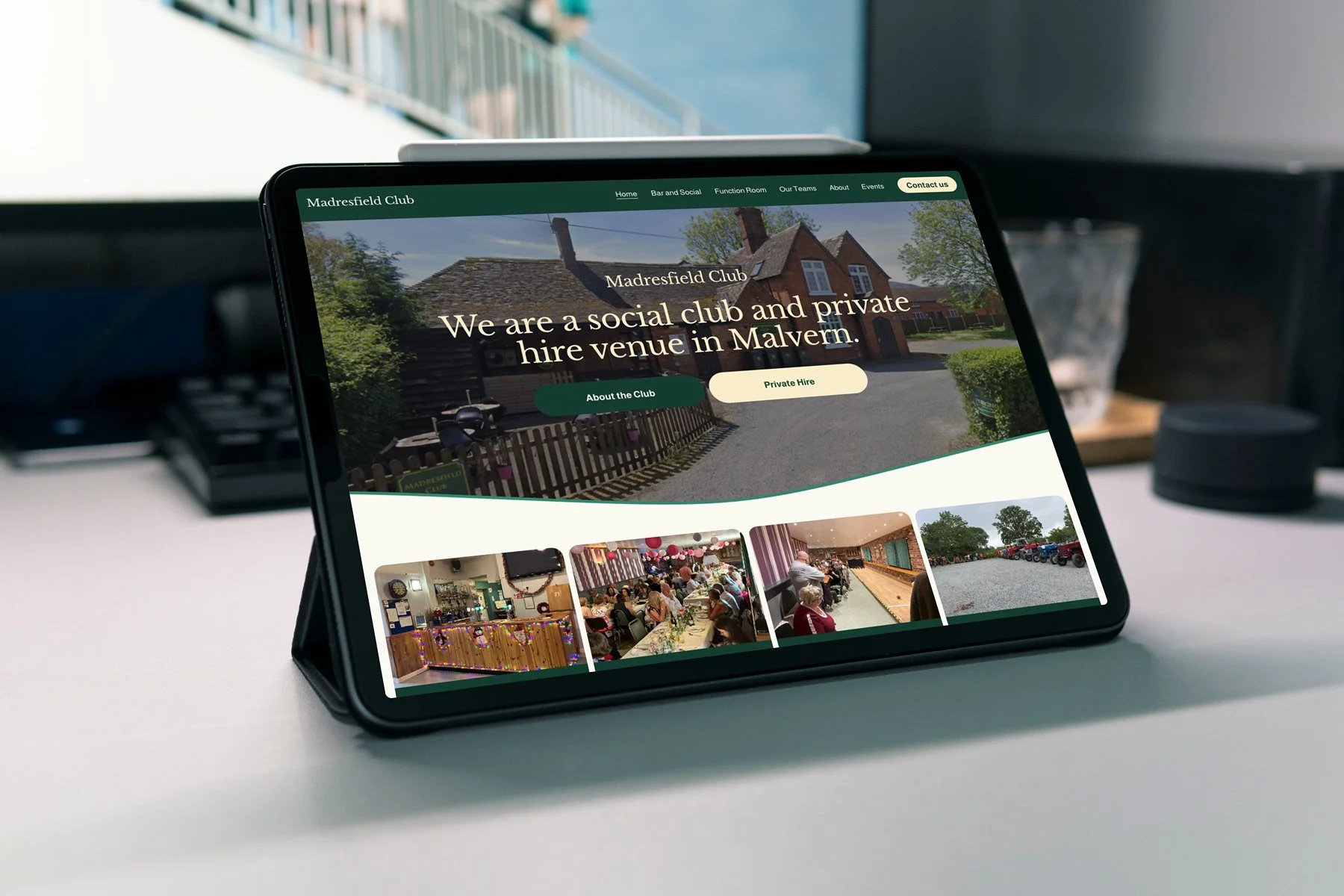
Madresfield Club launches new website to welcome new visitors
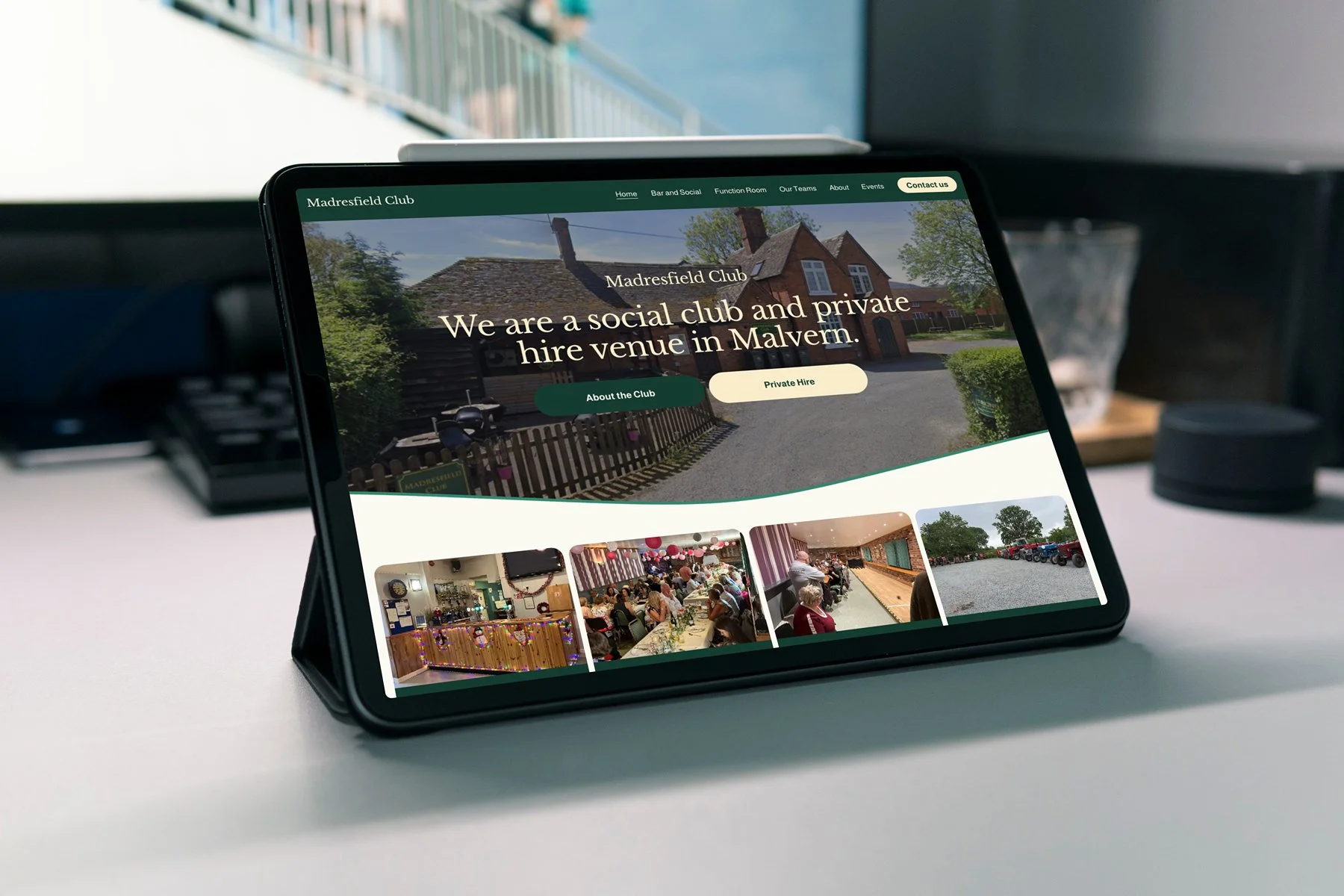
We've just launched a new website for Madresfield Club, the social club in Madresfield Village near Malvern.
The club has been part of the local community since 1894, but until now they had no real online presence beyond their Facebook page. That meant anyone searching for a venue near Malvern, or just looking for somewhere local for a drink, wouldn't find them.
We built them a new Squarespace site that shows off everything the club has to offer: a welcoming bar with proper club prices, a 60-seat function room available for private hire from just £20 an hour, and a home for their five skittles teams and darts squad.
Alongside the website, we put together a local SEO strategy to help them rank for venue hire searches in the Malvern area. That's already starting to pay off, with the club now appearing in results for the first time.
It's a great example of what a straightforward website and some targeted local SEO can do for a business that's been relying on word of mouth. Madresfield Club has been welcoming people for 130 years - now they've got a digital front door to match.
The new website can be found at www.madresfield-club.co.uk and you can read more about the project here.
Thanks for reading,
Ollie
Sign up to my free newsletter here for more news, useful tips, insights and guidance.
Your B2B Website Isn't Converting? Fix These 10 Things First
Your website's getting traffic. You can see it in the analytics. People are finding you, landing on your pages, having a look around. But then... nothing. No enquiry. No phone call. No email. They just disappear back into the internet like they were never there.
Sound familiar? Don’t worry because you're not alone.
It's one of the most common frustrations I hear from B2B service company owners, and after twenty-five years in senior management and now running a digital growth consultancy, I can tell you it's almost never a traffic problem.
It's highly likely to be a conversion problem.
And the good news is, most of the fixes are quick wins you can action this week.
Here are the ten things I'd check first, in order of priority. Number one is the one that catches out more businesses than any other. Number ten still matters, but if you haven't nailed the first few, nothing else will save you.
1. Your Value Proposition Is Vague (or Missing Entirely)
This is the big one. Land on most B2B service company websites and you'll see something like "Professional Solutions for Your Business" or "Delivering Excellence Since 2003." Lovely. But what do you actually do? Who do you do it for? And why should anyone care?
OK yes, the big corporations can swerve this but they’ve spend millions on establishing their brands so unless your pockets are very very deep you need ot be crystal clear on your value proposition.
A visitor needs to understand three things within five seconds of landing on your homepage: what you do, who you do it for, and what makes you different. If they have to scroll, click, or guess, they're gone. Your competitors are one tab away.
The fix is simple but requires honesty. Write one sentence that a stranger could read and immediately understand your business. If you can't do that, your website hasn't got a hope.
2. Your Call to Actions Are Weak, Hidden, or Confusing
"Click here." "Learn more." "Submit." These are not calls to action. They're polite suggestions that visitors happily ignore.
Every page on your website should have a clear, specific next step that tells the visitor exactly what happens when they click. "Get Your Free Quote" is better than "Contact Us." "Book a 15-Minute Call" is better than "Get in Touch." "Download Our Pricing Guide" is better than "Learn More."
And they need to be visible. Not buried at the bottom of the page beneath three paragraphs about your company history. Above the fold, in a contrasting colour, impossible to miss.
If someone has to hunt for how to contact you, they won't bother. They'll find a competitor who makes it easy.
3. Your Contact Form Is Putting People Off
I've seen B2B contact forms with fifteen fields. Company name, job title, department, postcode, phone number, how did you hear about us, what's your budget, what's your blood type. Every field you add is another reason for someone to abandon the form and move on.
For most B2B service companies, you just need three things: name, email, and a message box. That's it. You can qualify the lead on a call. Your job right now is to get the enquiry, not conduct an interview.
I know that many larger firms have more detailed forms and the purpose is to filter lead into the correct teams but just like with you value prop if you’re not yet ‘big business’ then it’s simply better to stack the odds in your favour.
If your form takes longer than twenty seconds to complete, it's costing you business. Strip it back, make it simple, and watch what happens.
4. There's No Quick Way to Call You
This sounds obvious in 2026, but go and look at your website on your phone right now. Can you tap a phone number and call immediately? Is it visible without scrolling? Is it on every page?
B2B buyers, particularly decision-makers in SMEs, often want to pick up the phone. They're busy. They don't want to fill in a form and wait for someone to get back to them next Tuesday. They want to speak to someone now, while they're thinking about it, while the problem is front of mind.
A clickable phone number in your header and a sticky mobile bar that follows visitors as they scroll. That's all it takes. If you're hiding your phone number on a contact page three clicks deep, you're losing warm leads every single day.
5. You've Got No Social Proof Where It Matters
Testimonials on a dedicated "Testimonials" page are fine, but barely anyone visits that page. The people who need convincing are on your homepage, your service pages, and your contact page. That's where your social proof needs to be.
Client logos, short testimonials, case study snippets, review scores — scatter them throughout your site wherever someone might be making a decision about whether to get in touch. A single relevant testimonial placed next to a call to action can dramatically shift conversion rates because it answers the question every visitor is silently asking: "Has this actually worked for someone like me?"
6. Your Website Isn't Mobile-First
Not mobile-friendly. Mobile-first. There's a difference.
We all lead busy lives and over half your traffic is likely coming from phones and tablets. If your website was designed on a desktop and then squeezed down for mobile, your visitors are getting a compromised experience.
Text too small, buttons too close together, images loading slowly, forms that are painful to complete with a thumb.
Open your website on your phone and try to complete an enquiry. Time yourself. If it takes more than thirty seconds or if anything feels frustrating, that's your conversion problem right there.
7. You're Talking About Yourself, Not Your Customer's Problems
"We were established in 2005. We have a team of experienced professionals. We pride ourselves on quality and customer service." Nobody cares.
I know it sounds harsh, but it's true.
Your visitors have a problem they need solved. They want to know that you understand their problem, you've solved it before, and you can solve it for them. The moment your website becomes about you rather than about them, you've lost the connection.
Flip the script. Instead of "We offer comprehensive IT support services," try "Sick of IT problems disrupting your business? We keep your systems running so you can focus on what you're good at." Same service, completely different impact.
8. Your Website Speed Is Killing You Before You Start
If your website takes more than three seconds to load, a significant percentage of visitors will leave before they've even seen what you do. They don't think "this site is slow, I'll wait." They think "this doesn't work" and hit the back button.
You can check your site speed for free on Google's PageSpeed Insights. If your score is below 70 on mobile, you've got a problem. Common culprits are oversized images, too many plugins, cheap hosting, and bloated code. Most of these can be fixed in an afternoon without redesigning anything.
9. Your Service Pages Are Thin and Generic
Your homepage might be decent, but what about your individual service pages? Too many B2B websites have service pages that are little more than a title, two paragraphs of generic waffle, and a "contact us" button.
Each service page should answer the questions a potential buyer is actually asking. What's included? How does it work? How long does it take? What does it cost (or at least a starting point)? Who is it for? What results can I expect? If your service page doesn't give someone enough information to feel confident about making an enquiry, they'll go and find a competitor whose page does.
10. You Have No Lead Magnet or Low-Commitment Entry Point
Not everyone who visits your website is ready to buy today. Some are researching, comparing, or just not quite sure yet. If the only option you give them is "contact us for a quote," you're losing everyone who isn't ready for that conversation.
A simple lead magnet — a downloadable guide, a checklist, a free audit, a pricing calculator — gives these visitors a reason to hand over their email address without committing to a sales conversation.
It keeps you on their radar and it positions you as helpful rather than pushy.
And it gives you a database of warm prospects you can nurture over time.
You don't need to build anything complicated. A well-written PDF guide relevant to your target audience is enough. Something genuinely useful that shows you know what you're talking about.
The Bottom Line
None of these fixes require a full website redesign. None of them need a massive budget. Most of them can be actioned within a week by anyone with basic access to their website's content management system.
The businesses that convert website traffic into enquiries aren't doing anything revolutionary. They're just making it ridiculously easy for the right people to understand what they offer and get in touch. That's it. No magic. No gimmicks. Just clarity, simplicity, and removing every unnecessary barrier between a visitor and an enquiry.
My favourite all tine example of this is a company called Stickermule.com and their website strategy is pure genius.
It is simplicity itself for the visitor and backed by a huge ‘manufacturing machine’ in the background, which having worked in the world of print I can only guess is highly systemised and complicated to the untrained eye.
But to the visitor looking to order some custom stickers - they’vee made it by design the simplest thing to do.
So take leaf out of their books. Start at number one. Work your way down. Fix what you can this week, plan what needs more thought, and stop blaming your traffic for a conversion problem.
Your visitors are already there. You just need to stop making it so hard for them to say yes.
Thanks for reading,
Ollie
Sign up to my free newsletter here for more news, useful tips, insights and guidance.
I've changed how we’re supporting local good causes
When I launched Midlands Digital back in the autumn of 2024, I made a commitment from day one that for every ten websites we built, we'd provide one completely free for a local charity, good cause, not-for-profit community organisation or someone that just really needed a helping hand.
It wasn't a marketing play. It was something I was genuinely proud to bake into the business.
We had the skills, the tools, and the passion — and these organisations were doing brilliant work across Herefordshire and Worcestershire without the budget to invest in a proper digital presence. So we rolled up our sleeves and stepped in.
And we didn't cut corners. Every charity project got the same treatment as a paying client.
We’d sit down to understand the organisation inside out, attending meetings, researching their audience, developing branding and graphic design from scratch.
Then we’d build a fully optimised website. Connecting domains. Testing. Refining. Launching. Hours and hours of considered, professional work — because these causes deserve the same quality as any commercial project.
To cap it off on top of the website build itself we also covered all associated costs for the first year. Hosting fees, professional email setup, and any third-party platform subscriptions needed to keep things running — tools like Calendly for bookings, Google Workspace, Mailchimp for newsletters, and whatever else the organisation needed to operate effectively online.
We also provided a full local SEO setup including Google Business Profile optimisation, Search Console submission, analytics configuration, and call tracking.
Everything handed over ready to go, at no cost whatsoever.
Well, almost no cost…!
We did ask just one thing in return.
Tag us in a single social media post when you announce your new website is live. That's it. Nothing more. Not a retainer. Not a referral fee. Not ongoing credit. Just one tag, one time, when the site goes live.
And I'll be honest about why that mattered to us. Charities have incredible communities behind them — supporters, volunteers, local business owners who care about the same causes.
A simple tag would introduce us to that audience and, hopefully, spread the word that we're a local business genuinely committed to doing good work for good causes. That exposure could lead to more opportunities with other local businesses and we’d then be able to help other good causes in the future.
We hoped it would cause a snowball effect of mutually beneficial good-will, where one project naturally led to the next.
That was the whole point but unfortunately - and here’s the reality check time - that never quite happened.
Despite delivering every project to the same standard we'd expect from a fully paid brief, when I looked back none of the organisations we supported followed through on that one tiny request.
And while I completely understand that charities are busy, stretched, and focused on far more important things than social media — it did make me take a step back and rethink whether this model was really working the way we'd hoped.
Because while the work was always free, it still represented a real investment of time, expertise, and money from our side. I was always happy to make that commitment — but over time, it became clear that a different approach would be fairer for everyone involved.
So I've rethought it…
What happens now for 2026
Rather than stepping away from supporting good causes altogether, my pledge is that Midlands Digital will now donate 5% of all profits from website builds to a nominated local charity each year.
That’s real money, going to a good cause doing real work in the local community. Alongside this we will offer a 10% reduction in cost to any local good causes who want to use our services.
I think it's consistent, sustainable and balanced. And honestly, I think it'll make a bigger difference in the long run than the occasional free website ever could.
I still believe passionately in giving back locally. That hasn't changed one bit but I think we've just found a better way to do it.
Thanks for reading,
Ollie
Sign up to my free newsletter here for more news, useful tips, insights and guidance.

I've joined the Herefordshire & Worcestershire Chamber of Commerce
I've spent the last few years building Midlands Digital from home. From the ground up, head down, doing the work, getting results for clients.
But here's the thing about working from home: you don't bump into people. There are no coffee chats, no golf days ( I don’t play golf but you get the jist), no "we should grab a beer" moments. And for a business like mine—where trust matters and most clients come through relationships—that's presets a problem.
So fast forward to today I've done something about it and this week, Midlands Digital officially became a member of the Herefordshire & Worcestershire Chamber of Commerce.
Why the Chamber?
This isn't my first time through the Chambers doors. Over the years, I've attended Chamber events as part of other businesses I've worked for. I've seen first-hand what it offers—and more importantly, who's in the room.
Not heavy handed marketers or motivational gurus. Actual business owners—running companies, making decisions, trying to grow. The kind of people I enjoy talking to and working with.
I always found value in those events. Good conversations, useful connections, and the kind of relationships that only happen when you're actually present. So when it came to getting Midlands Digital more visible locally, the Chamber was an obvious choice.
I'm not expecting to walk into a networking event and walk out with five new clients. If you are then a heads-up that's not how it works. But I do know that the best business relationships I've had started with a conversation, and weirdly for me considering what I do - not from a Google search.
What this means for Midlands Digital
Not much changes day-to-day. I'll still be doing the same work—helping owner-run SMEs get their marketing sorted. Strategy, websites, SEO, content. All joined up, all going somewhere.
But I'll be more visible locally, more involved and more present.
If you're a Chamber member and we haven't met yet, come and say hello at an event. I promise I won't try to sell you anything—I'd rather just have a decent conversation.
And if you're a business owner in the region wondering whether the Chamber is worth joining, my early take is: if you're serious about building relationships locally, it probably is.
Here's to getting out a bit more.
Thanks for reading.
Ollie
Sign up to my free newsletter here for more useful tips, insights and guidance.
January 2026 SEO roundup
If you've noticed your phone ringing a bit less or your Google Business Profile stats looking different lately, you're not imagining things. January brought a stack of changes that affect how local businesses show up in search - some helpful, some you need to adapt to.
Here's what changed this month and what you should do about it.
1/ The December Core Update Finally Settled
Google's December 2025 Core Update finished rolling out on New Year's Day. According to ALM Corp's analysis, rankings have now stabilised and recovery efforts typically show results within four to eight weeks.
The good news if you run a legitimate local business? The same analysis found that local businesses with strong reputations and genuine expertise generally maintained their rankings. It was the "SEO-optimised location pages without substance" that took a hit. In other words, if you've been doing things properly - serving customers well and building a genuine reputation - you're likely fine.
2/ Google's Killing the Q&A Feature on Maps
This one's worth paying attention to. Barry Schwartz at Search Engine Roundtable confirmed that Google is removing the Q&A feature in Google Maps and replacing it with an AI-powered "Ask" button.
If you've spent time carefully answering questions on your Google Business Profile - or even better, pre-seeding it with common questions and answers - that content is going away. Don't let it disappear completely. Copy those Q&As across to your website's FAQ section before they vanish. That content still has value, just in a different home.
3/ Post Scheduling Is Finally Here
On the positive side, Sterling Sky reports that Google has officially launched scheduling and multi-location publishing for Google Posts. This has been a long time coming.
If you've been putting off regular Google Posts because it's yet another thing to remember, this removes that excuse. You can now batch your posts in one sitting and schedule them out. For anyone managing multiple locations, the multi-location publishing means you don't have to repeat the same task across every profile.
4/ Reviews Are Changing - In Several Ways
There's been a few shifts around reviews this month that are worth understanding.
First, anonymous reviews are now widespread. Since late 2025, Google Maps has been rolling out an option allowing users to display a nickname and profile photo instead of their real identity when posting a review. Google says this will encourage more people to leave reviews, particularly for sensitive services like healthcare or legal. The flip side is that savvy customers may trust these less.
Second, your responses to reviews are now being pre-moderated by Google. The same source confirms that responses are reviewed to ensure they comply with content rules, can be rejected with a request for editing, and the delay is often up to 10 minutes but sometimes up to 30 days. Bear this in mind if you're dealing with a negative review and want to respond quickly - there may be a delay before your reply appears.
Third, Google is now sending email notifications when review restrictions on your profile have been lifted - handy if you've been flagged in the past.
5/ Service Areas Might Actually Matter Now
For years, the consensus among local SEO professionals was that service area settings didn't really influence rankings. Sterling Sky's latest updates suggest that may be changing based on what they're seeing in the API. If you're a service-area business and haven't reviewed those settings recently, it's worth double-checking they accurately reflect where you actually work.
6/ The Bigger Picture: Clicks Are Down Even When Rankings Are Up
Here's the trend that should concern every local business owner. Joy Hawkins at Sterling Sky analysed 179 Google Business Profiles across 34 law firms and found something troubling: even businesses ranking really well are seeing calls from their business profile declining over time.
It's not that the traffic is going to ChatGPT - that's still only about 2% of what Google delivers for most businesses. The issue is that Google's AI Overviews are changing how people interact with local search results.
The Wellsville Sun summarises it well: for local queries like "coffee shop near me," users are now seeing curated summaries, recommendations, and business highlights often before traditional listings even come into view. This means fewer clicks, more zero-click searches, and higher expectations for accuracy and authority.
7/ What's Changed in Search Console
If you use Google Search Console (and trust me you should), there are some genuinely useful updates this month. Swipe Insight's roundup covers the key changes: weekly and monthly views have been added to the Performance report, making it easier to spot trends without the noise of daily fluctuations. There's also a new branded queries filter that separates traffic from people who already know your business name from those discovering you for the first time.
Your One Thing to Do This Week
Log into your Google Business Profile and save your Q&A content somewhere before it disappears. Copy it into a document, then add it to your website's FAQ page. It took you time to build that content - don't let Google's changes waste it.
Thanks for reading,
Ollie
Sign up to my free newsletter here for more useful tips, insights and guidance.
Why Your Old Five-Star Reviews Might Be Costing You Customers
You’ve done the hard work. You’ve collected dozens of glowing reviews over the years. Your Google Business Profile sits proudly at 4.8 stars. So why is the business down the road—the one that’s only been going for 18 months—getting more calls than you?
The answer might surprise you: your reviews are stale.
Google cares about what’s happening now
Here’s something most business owners don’t realise. Google doesn’t just count your reviews and calculate an average. It pays close attention to when those reviews were left. A business with 200 reviews from three years ago looks very different to Google than one with 50 reviews from the last six months.
Why? Because Google wants to show searchers businesses that are active, reliable, and currently delivering good service. A flood of old reviews tells Google one thing: this business used to be good. Recent reviews tell a different story: this business is good right now.
When someone searches for “plumber near me” or “best Italian restaurant in Manchester,” Google’s job is to surface businesses that will satisfy that searcher today. Fresh reviews are one of the strongest signals that you’re still in the game and still delivering.
Your potential customers think the same way
Put yourself in a customer’s shoes for a moment. You’re looking for a local accountant. You find two options. The first has 150 reviews, mostly from 2019 to 2021, with nothing in the last year. The second has 60 reviews, with a dozen posted in the last three months.
Which one feels like the safer bet?
Most people will choose the second option without even thinking about it. Those recent reviews answer an unspoken question: “Are they still any good?” Radio silence for 12 months creates doubt. It makes people wonder if something’s changed, if the owner has retired, or if quality has slipped.
I’ve seen this play out countless times. A business owner will ring me frustrated because their competitor—who frankly isn’t as good—keeps winning the work. When we dig into it, the pattern is almost always the same. The competitor has a steady stream of recent reviews. My client has a dusty collection of old ones.
The three-month window that matters most
While there’s no magic number, a useful rule of thumb is to think about your last 90 days of reviews. This is roughly the window that carries the most weight, both for Google’s algorithm and for customers scanning your profile.
Ask yourself: how many reviews have you received in the last three months? If the answer is zero or one, you’ve got a recency problem. It doesn’t matter how many five-star reviews you collected back in 2022.
This doesn’t mean old reviews are worthless. They still contribute to your overall rating and review count. But they’re not doing the heavy lifting anymore. Think of them as your foundation, not your selling point.
Why most businesses let this slide
The typical pattern goes like this. A business launches, the owner hustles hard for reviews, they build up a solid collection, and then they stop asking. Life gets busy. The reviews keep trickling in occasionally, but nowhere near the rate of those early days.
Meanwhile, a newer competitor enters the market. They’re hungry. They ask every customer for a review. They respond to each one promptly. Their profile looks active and alive. Yours looks like a museum exhibit.
The frustrating part is that you’re probably still doing great work. Your customers are still happy. You’ve just stopped capturing that proof in a way that Google and future customers can see.
The fix is simpler than you think
You don’t need 20 reviews a month. You don’t need to hassle every customer. You just need a consistent trickle of recent reviews to keep your profile looking fresh and active.
The easiest approach is to build review requests into your normal workflow. Send a follow-up message after every job or sale. Make it easy—include a direct link to your Google review page. Thank customers who do leave reviews by responding promptly.
Even two or three reviews a month will transform a stale profile into an active one within a quarter. That steady rhythm matters far more than occasional bursts followed by long silences.
Your one thing to do this week
Go to your Google Business Profile right now and scroll through your reviews. Note the date of your most recent one. If it’s more than a month old, text or email your last three happy customers today and ask if they’d mind leaving a quick review. Include the direct link to make it effortless.
That’s it. No complicated systems, no software, no expense. Just a simple ask to people who already like what you do.
Fresh reviews beat old five-stars every time. The businesses winning in local search aren’t necessarily the best at what they do—they’re the best at proving it, consistently, over time.
Thanks for reading,
Ollie
Sign up to my free newsletter here for more useful tips, insights and guidance.
Your Phone Photos Could Be Doing Hidden SEO Work
Every time you finish a job, you probably snap a quick photo. Maybe it goes on your Google Business Profile, perhaps Facebook, possibly nowhere at all. But here’s what most local business owners don’t realise: those photos contain invisible data that Google actually reads. And if you’re not paying attention to it, you’re leaving easy wins on the table.
Let me explain what I mean, and more importantly, what you can do about it starting today.
The invisible location data already in your photos
Every photo your phone takes can include something called EXIF metadata – essentially hidden information embedded in the image file. If you’ve got location services enabled for your camera, this includes the exact GPS coordinates of where the photo was taken.
Here’s why that matters: Google can read this data.
When you upload a photo to your Google Business Profile that was taken at a customer’s house in Birmingham, Google knows that image was captured in Birmingham. That’s a geographic signal linking your business to that location. Now multiply that across dozens of job photos over months and years. You’re building a web of location signals that tell Google exactly where you operate.
The beauty of this is it’s almost entirely automatic. Your phone does the work. You just need to make sure the setting is switched on – and many people have it turned off without realising.
For your Google Business Profile, GPS data is the win
When you upload images to your Google Business Profile, Google compresses and reprocesses them. Your original filename often gets changed internally, so spending time renaming photos before uploading to GBP isn’t where your effort should go.
The real value is in that embedded location data. A geo-tagged photo of a completed kitchen installation in Solihull tells Google something meaningful about where you work. A photo with no location data is just pixels.
This is genuinely low-effort, high-impact stuff. You’re not learning new skills or spending money. You’re just making sure your phone is set up correctly and then carrying on as normal – taking photos of your work like you probably already do.
For your website, it’s a different story
Here’s where things change. When you upload images to your website, most content management systems and image optimisation tools strip out that EXIF metadata during processing. Your GPS coordinates often don’t survive the upload.
So for website images, you need to be more deliberate. This is where filenames and alt text earn their keep.
Instead of uploading “IMG_4521.jpg”, rename it to something descriptive like “kitchen-renovation-solihull.jpg” before uploading. Google reads filenames as a signal for understanding what an image shows. Keep it readable, use hyphens between words, and include the location where it’s natural.
Alt text is your other opportunity. This is the short description you can add to images in your website’s media library – primarily an accessibility feature for screen readers, but also read by search engines. Write what you’d say if describing the photo to someone who couldn’t see it: “New composite front door installation in Redditch” tells both humans and Google exactly what they’re looking at.
Your jobs are your proof – document them properly
Every completed job is content waiting to happen. That new driveway, the rewired kitchen, the freshly landscaped garden – these aren’t just finished projects, they’re visual evidence that you do good work in specific areas.
Get into the habit of photographing your work consistently. For Google Business Profile uploads, the GPS data does the heavy lifting automatically. For your website, take an extra minute to rename files and write proper alt text before uploading.
This isn’t complicated once it becomes routine. But those small efforts compound into genuine local SEO signals over time.
How to check your phone is set up correctly
This takes two minutes and you only need to do it once.
On iPhone, open Settings, scroll down to Privacy & Security, tap Location Services, then scroll down to Camera and make sure it’s set to “While Using the App”. That’s it – your photos will now include GPS coordinates automatically.
On Android, open your Camera app, tap the settings cog, and look for “Location tags”, “Geo tags”, “GPS tags” or “Save location” – the wording varies by manufacturer. Make sure it’s switched on.
To check it’s working, take a photo and view its details. On iPhone, open the photo, swipe up, and you should see a map showing where it was taken. On Android, open the photo, tap the three dots for info or details, and look for location data.
If your recent photos don’t show location information, the setting was probably off. No problem – just switch it on now and every photo from here onwards will include it.
Your one thing to do this week
Check your phone’s camera settings today and make sure location tagging is switched on. Then photograph your next completed job and upload it to your Google Business Profile. That’s it. One properly geo-tagged image, doing invisible SEO work for you.
Most of your competitors aren’t doing this. Their photos are location-less and invisible to Google beyond the pixels. Yours don’t have to be.
Thanks for reading,
Ollie
Sign up to my free newsletter here for more useful tips, insights and guidance.
The Boring Detail That's Quietly Wrecking Your Google Visibility
There's a reason this topic doesn't get much airtime. It's not exciting. It's not a quick hack or a secret trick. It's admin, really. But if you're a local business trying to show up on Google, getting this wrong can undo everything else you're doing right.
I'm talking about NAP consistency. That stands for Name, Address, Phone number. And if yours don't match up across the internet, Google gets confused about who you actually are.
Why Google cares about your details
Google's job is to show searchers the most relevant, trustworthy results. When someone searches "roofer in Nottingham" or "dog groomer near me", Google has to decide which businesses to display. One of the ways it figures out which businesses are legitimate and established is by checking whether their information is consistent across the web.
If your business name is "Smith & Sons Plumbing" on your website, "Smith and Sons Plumbing Ltd" on Yell, "Smiths Plumbing" on Checkatrade, and "Smith & Sons" on Facebook, that's a problem. Google sees those inconsistencies and starts to doubt whether these are all the same business. The same applies to your address and phone number.
It's not that Google will remove you from search results entirely. But when it's deciding between you and a competitor who has clean, consistent information everywhere, you're at a disadvantage.
Where these inconsistencies come from
Most business owners don't deliberately create this mess. It builds up over time without anyone noticing.
You registered on a directory years ago when you worked from a different address. You changed your phone number but only updated it in some places. You incorporated and added "Ltd" to your name on some listings but not others. You let an old Yellow Pages listing sit there gathering dust. A directory scraped your information from somewhere and got it slightly wrong.
Before you know it, your business details are scattered across dozens of websites, and half of them don't quite match up.
The places that matter most
Your NAP appears in more places than you might realise. Your own website, obviously. Your Google Business Profile. Facebook. Instagram if you've added contact details. Yell, Thomson Local, Yelp, Checkatrade, MyBuilder, TrustATrader, Bark, and countless other directories. Industry-specific sites for your trade. Your local chamber of commerce if you're a member. Anywhere you've ever submitted your details or had them listed.
Some of these matter more than others. Your Google Business Profile is critical and should be your single source of truth. Major directories like Yell still carry weight. Industry-specific directories relevant to your trade are worth keeping accurate. Random listings on obscure sites matter less, but if you can fix them easily, it doesn't hurt.
How to find and fix the problem
Start by deciding what your correct NAP should be. Write it down exactly as you want it to appear everywhere. The precise business name you use (with or without Ltd, with "&" or "and", any specific formatting). Your current trading address. Your main phone number.
Then search for your business online. Google your business name on its own. Google your business name plus your town. Google your phone number. Google your old phone number if you've changed it. See what comes up.
Make a list of everywhere you find yourself mentioned. Note which listings have the correct information and which don't. Then work through them one by one. Some directories let you claim and edit your listing. Others you'll need to contact directly to request a correction. A few might be impossible to change, but most can be fixed with a bit of persistence.
Keeping it clean going forward
Once you've tidied things up, maintain it. Whenever you update your details anywhere, update them everywhere. Keep a record of all the places your business is listed so you know what needs changing if you move premises or get a new phone number.
If you ever rebrand or change your business name, treat your online listings as a priority, not an afterthought. The longer incorrect information sits out there, the more it can affect your visibility.
Your one thing to do this week
Google your business name plus your town and look at the first two pages of results. Open every listing you find and check whether your name, address, and phone number are correct and consistent. Make a note of anything that needs fixing. Then pick the three most important listings, the ones on well-known sites, and get those corrected first. It's not glamorous work, but it's the foundation everything else sits on.
Thanks for reading,
Ollie
Sign up to my free newsletter here for more useful tips, insights and guidance.
Your Contact Page Is Probably Losing You Customers.
Most local business websites treat the contact page as an afterthought. It's usually the last page built, gets the least attention, and ends up being nothing more than a lonely form floating in a sea of white space. Name, email, message, submit. Job done.
Except it's not done. That bare-bones approach is quietly costing you enquiries.
Think about it from your customer's perspective. They've browsed your site, liked what they've seen, and now they're ready to get in touch. They land on your contact page and find... a form. No phone number prominently displayed. No indication of when they might hear back. No reassurance that a real person is on the other end. Just a form that disappears their message into the void.
Some people will fill it in anyway. But plenty won't. They'll hit the back button and try the next business on Google instead.
Give people options, not obstacles
Not everyone wants to fill in a form. Some people prefer to pick up the phone. Others would rather send a WhatsApp message or fire off a quick email. Younger customers might want to reach you through social media. Older customers often don't trust forms at all.
Your contact page should cater to all of them. Display your phone number prominently, and make it clickable so mobile users can tap to call. Include your email address as a proper mailto link. If you use WhatsApp for business, add a direct link to start a chat. List your social media profiles if you actually respond to messages there (and only if you do).
The form can still be there for people who prefer it. But it shouldn't be the only way to reach you.
Tell them what happens next
One of the biggest reasons people abandon contact forms is uncertainty. They don't know if their message will actually reach anyone, how long they'll wait for a response, or whether they'll get a response at all.
Fix this by setting clear expectations. Add a simple line underneath your form: "We typically respond within 24 hours during working days." Or "I'll get back to you within one business day, usually sooner." Whatever your actual response time is, state it.
If you have specific working hours, mention them. "I'm available Monday to Friday, 8am to 6pm" tells the customer exactly where they stand. It also explains why they might not hear back immediately if they contact you at 9pm on a Saturday.
Show them you're a real person (or real people)
A contact page with nothing but a form feels impersonal and slightly suspicious. Is there actually someone at this business? Where are they based? Can they be trusted?
Combat this by adding some human elements. Include a photo of yourself or your team. Add your business address, even if you don't have a physical shop front. Mention the areas you cover if you're a service business. A brief line like "Based in Sheffield, covering South Yorkshire" or "Serving customers across Bristol and Bath" adds credibility and helps local customers feel they're dealing with someone nearby.
If you have reviews or testimonials, consider adding one or two to your contact page. Someone who's on the fence about getting in touch might be nudged over the line by seeing that other customers had a good experience.
Make it mobile-friendly (properly)
More than half of your website visitors are probably on their phones. Yet many contact pages are awkward to use on mobile devices. Forms with tiny fields. Phone numbers you can't tap to call. Addresses that don't link to maps.
Check your contact page on your own phone. Can you easily tap the phone number to call? Is the form simple to fill in without zooming? Does your address link to Google Maps so people can get directions? These small details make a big difference when someone's trying to contact you while standing outside a job site or sitting in their van.
Your one thing to do this week
Pull up your contact page on your mobile phone right now. Try to use it as if you were a potential customer. Call your own number using the link (or notice that you can't because it's not clickable). Fill in the form. See how the experience feels.
Then add at least one more way for people to reach you. A prominent phone number if you only have a form. A WhatsApp link if you use it. An email address as a backup. Give your customers options, and more of them will take you up on the offer.
Thanks for reading,
Ollie
Sign up to my free newsletter here for more useful tips, insights and guidance.
Your Google Business Profile Is Gathering Dust. Here's How To Fix It (From Your Sofa)
You set it up. Probably a few years ago. Maybe you remember doing it. Maybe you don't.
Your Google Business Profile is sitting there right now, on Google Maps, showing up (or not showing up) in local searches. And unless you've been actively maintaining it, it's costing you business.
The problem? Most small business owners don't even remember how to access it anymore.
"What's my password again?" "Which email did I use?" "Where do I even log in?"
Sound familiar?
Here's the good news: you don't need to be sat at a desktop with a cup of tea and your brain switched on. You can do this from your sofa on your phone. And it takes about 10-15 minutes every couple of weeks to keep your profile working hard for you.
Here's exactly how.
How To Access Your Profile (If You Remember Your Login)
Via Google Business Profile (The Proper Way):
On your phone, open Google Chrome (or your default browser)
Go to google.com/business
Tap the Sign In button (top right)
Enter the email address you used to set up your profile
Enter your password
You'll see a list of your business profiles (if you have more than one)
Tap the one you want to manage
That's it. You're in.
Via Google Maps (The Easier Way):
Open Google Maps on your phone
Tap your profile icon (bottom right)
Tap Your Business Profile or Manage Your Business
Search for your business name
Select your business from the results
You'll see an "Manage" or "Edit" button—tap that
This is often faster if you just need to make quick updates.
How To Access Your Profile (If You've Forgotten Your Login)
This happens more often than you'd think. You set it up years ago, used a random password, never saved it anywhere.
If you've forgotten your password:
Go to google.com/business
Tap Sign In
Enter the email address you think you used
Tap "Forgot password?"
Google will ask you to verify your identity (usually by sending a code to your recovery email or phone)
Follow the prompts to reset your password
Log in with your new password
If you've forgotten which email you used:
This is trickier, but doable.
Go to google.com/business
Tap Sign In
Try common emails you might have used (main business email, personal email, old email)
If one works, great—proceed with password recovery
If none work, tap "Can't sign in?" and follow Google's account recovery process
If you genuinely can't remember anything, you can verify ownership of your business another way. Google will ask for business documents or a phone verification code sent to your business number.
Once You're In: The Weekly Maintenance Checklist
Okay, so you've logged in. Now what? Here's what actually matters:
1. Update Your Business Details (5 minutes)
Tap "Business Info" or "About"
Check:
Business name (spelled correctly, no random capitals or symbols)
Phone number (is it current? Can people actually reach you?)
Address (still correct? Updated recently?)
Website (if you have one—is the link working?)
Business hours (do they match reality? Updated for holidays or changes?)
Small changes here make a massive difference. A wrong phone number costs you jobs. Out-of-date hours frustrate customers.
2. Add Or Update Your Services (5 minutes)
This is the bit most people miss.
Tap "Services" (or "Products" depending on your business type)
Add every service you actually offer. Don't be vague.
Instead of: "Cleaning" Write: "Commercial office cleaning," "End of tenancy cleaning," "Deep carpet cleaning"
Why? Because customers search specifically. They're looking for "lock changes" or "emergency locksmith," not just "locksmith services." The more detailed your services list, the more likely you show up for what people are actually searching for.
3. Add Your Service Areas (3 minutes)
Tap "Service Areas"
List every area you actually serve. Be specific:
"Malvern, Worcestershire" rather than "West Midlands"
If you serve multiple towns or postcode areas, add them all. This tells Google (and your customers) where you operate.
4. Add Photos (5 minutes)
This matters more than people think.
Tap "Photos" or "Gallery"
Add photos of:
Your work in progress (shows competence)
Finished jobs (shows quality)
Your team (builds trust)
Your workspace or van (shows you're professional)
Don't use stock photos. Real photos of real work beat polished nonsense every time. Customers want to see what you actually do.
Recent photos matter too. Google prioritizes fresh content. If your photos are from 2022, update them.
5. Check Your Reviews (2 minutes)
Tap "Reviews"
Read through recent reviews. Respond to them—especially the good ones (say thanks) and the bad ones (address the issue professionally).
This shows you're actively managing your profile. It also shows Google that your profile is maintained and current.
Why You Should Do This Every Couple Of Weeks
I know what you're thinking. "Every couple of weeks? That's loads of work."
It's not. It's 15 minutes. From your sofa. On your phone.
Here's why it matters:
Google rewards fresh, updated profiles with better visibility. A profile that's actively maintained shows up higher in searches than a neglected one.
Customers trust maintained profiles more. Recent photos. Updated information. Responded-to reviews. These things signal that you're a business that cares.
Your competitors probably aren't doing this regularly. That's your competitive edge.
The Reality Check
One of your competitors probably has a better website than you. That's fine. But I guarantee they're not maintaining their Google Business Profile fortnightly. So while they're focused on their website, you're the one showing up in the Map Pack with up-to-date information and recent photos.
That's the job you win.
Where To Start
If your profile is currently a mess—outdated information, no photos, incomplete details—don't panic. You don't have to fix everything at once.
Tonight, from your sofa:
Log in (using the steps above)
Update your phone number and hours (5 minutes)
Add a couple of recent photos of your work (5 minutes)
Add your service areas if they're missing (3 minutes)
That's it. You've just improved your profile significantly.
Then, make a note to do a full check every couple of weeks. Not because it's a chore. But because it's the easiest way to stay visible in local search.
Your Google Business Profile isn't a one-time setup. It's an ongoing sales tool. Treat it that way and it'll work hard for you.
Thanks for reading,
Ollie
Sign up to my free newsletter here for more useful tips, insights and guidance.